CJC-1295 (without DAC)
Shorter-acting modified GHRH analogue often marketed as Mod GRF (1-29)
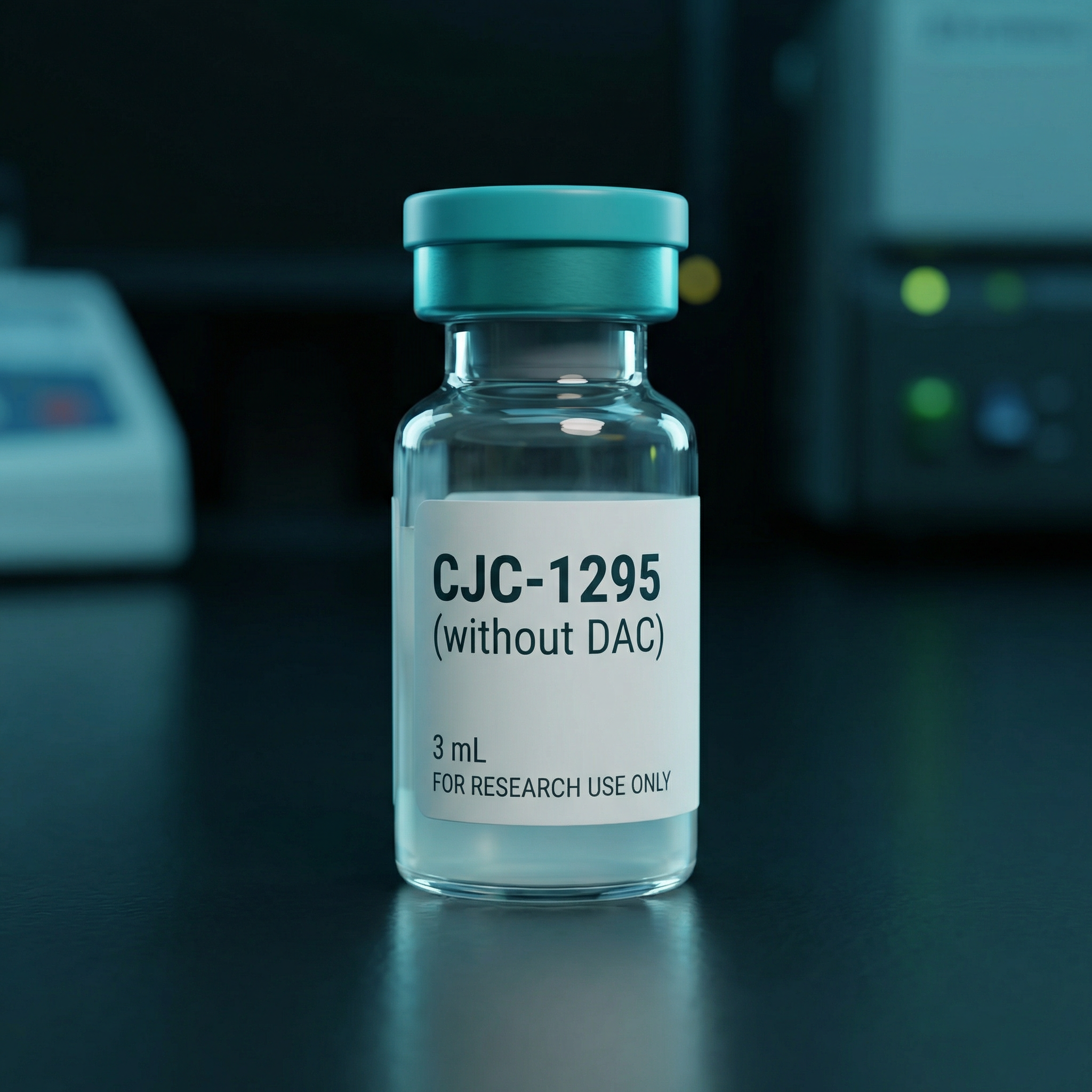
CJC-1295 without DAC is the shorter-acting modified GHRH analogue commonly marketed as Mod GRF (1-29). It sits in the same gray-market family as DAC-containing CJC-1295 but should be treated as a separate entry because its duration, exposure profile, and evidence base are materially different.
Common naming includes CJC-1295 without DAC, modified GRF (1-29), and Mod GRF 1-29. The FDA has explicitly distinguished the with-DAC and without-DAC forms in compounding-review materials, which supports keeping them as separate repository records.
Like the DAC form, the no-DAC peptide is designed to stimulate endogenous GH release through GHRH-receptor signaling. The difference is kinetic: without the Drug Affinity Complex extension, activity is intended to be shorter and more pulse-like rather than prolonged.
Online promotion focuses on physique, recovery, sleep, and anti-aging claims, often in combination with ghrelin mimetics such as ipamorelin. Those claims should be labeled as non-approved. No mainstream therapeutic indication was identified.
Available public materials and historical descriptions indicate a much shorter half-life than with-DAC CJC-1295, on the order of minutes rather than days. That makes route timing and injection frequency very different from the long-acting DAC formulation.
Evidence is weaker than for the DAC form. The biological rationale is plausible and the analogue is clearly capable of stimulating the GH axis, but there is little high-quality mature clinical literature demonstrating durable health or body-composition benefit in humans.
Safety is incompletely characterized. The broader FDA concern around CJC-1295-related substances includes immunogenicity, peptide-impurity complexity, and limited clinical data, and those cautions should carry into this entry. Unregulated sourcing magnifies the risk profile.
Because no approved label exists, dosing should be archived only as source-specific historical or research information. Internet schedules are highly variable and should not be normalized into repository recommendations.
UNVERIFIED RESEARCHER-REPORTED DOSING INFORMATION
The following dosing information has been compiled from community forums, researcher discussions, and gray-market sources. This information has NOT been verified through peer-reviewed scientific studies or clinical trials. It does NOT constitute medical advice, a prescription, or a recommendation for human use.
This data is presented solely for informational and educational purposes to document what is commonly discussed in research communities. Dosing protocols may be inaccurate, dangerous, or based on anecdotal reports with no scientific validation. Individual responses vary significantly, and unregulated compounds carry inherent risks including contamination, mislabeling, and unknown side effects.
Always consult qualified medical professionals before making any health-related decisions. The repository maintainers assume no liability for the use or misuse of this information.
Researcher-Reported Dosing Protocols
Common Dose Range: 100-300 mcg per injection
Administration Route: Subcutaneous injection
Frequency: 1-3 times daily
Timing: On an empty stomach, either in the morning, post-workout, or before bed. It is often recommended to wait at least 30-60 minutes after injection before consuming food.
Schedule / Protocol: 12-16 week cycles. Some sources suggest a '5 days on / 2 days off' protocol to maintain receptor sensitivity.
Dose Escalation: No specific dose escalation or titration approach is commonly discussed. Researchers typically start with the intended dose.
Additional Notes: CJC-1295 without DAC has a short half-life of approximately 30 minutes, which is why it requires multiple daily injections to maintain elevated growth hormone levels. It is very commonly stacked with a GHRP like Ipamorelin to create a synergistic effect on growth hormone release.
This researcher-reported dosing information was compiled from unverified community sources and does not represent validated scientific or medical guidance.
No major mature clinical-development pathway for the no-DAC form was identified during this update. Relative to the DAC form, the without-DAC entry should be tagged as less clinically characterized.
Not approved by the FDA or EMA. Best categorized as non-approved, clinically undercharacterized, and frequently marketed through research-chemical channels.
This entry needs particularly careful source control because many vendors use overlapping names and may not clearly distinguish sequence, salt form, or whether DAC is present. Repository records should therefore emphasize identity verification as a core data field.
Version 0.1 starter entry created March 14, 2026. Evidence basis for this draft: FDA compounding-review materials distinguishing with-DAC and without-DAC forms, public scientific descriptions of modified GRF analogues, and available clinical-development references at time of writing.