DSIP
Delta sleep-inducing peptide; controversial nonapeptide with mixed sleep and neuroregulatory evidence
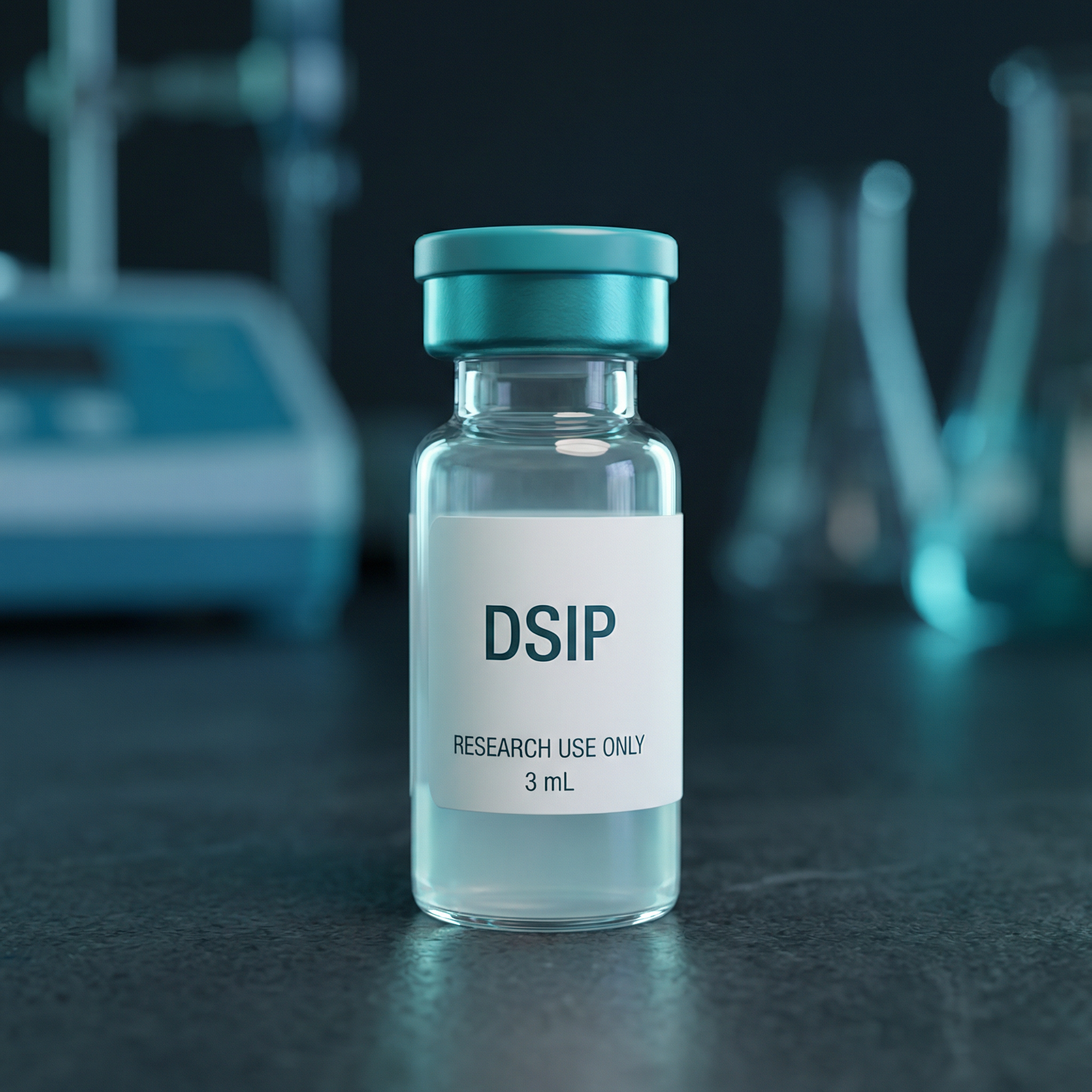
DSIP, or delta sleep-inducing peptide, is a nonapeptide that has circulated for decades in sleep, stress, and neuroendocrine research. It is one of the more controversial entries in the repository because the biology is real enough to sustain long-running investigation, but the clinical evidence base is inconsistent and incomplete. It should therefore be tagged as experimental and mechanistically unresolved.
Standard names include delta sleep-inducing peptide and DSIP. Older literature sometimes frames it as an endogenous sleep factor, while later discussions are more cautious because precursor biology and receptor assignment remain unclear. Repository aliases should preserve both the full name and the abbreviation.
3. Sequence and structure
DSIP is a linear nonapeptide with the sequence Trp-Ala-Gly-Gly-Asp-Ala-Ser-Gly-Glu, commonly abbreviated WAGGDASGE. It is a small peptide of roughly 849 Da and is typically represented without unusual cyclization or lipidation. The repository should store the exact sequence because many fragments and analogs also exist in the literature.
Mechanism remains unsettled. DSIP has been linked to sleep architecture, stress regulation, endocrine signaling, and possible NMDA or broader neuromodulatory effects, but no universally accepted receptor model anchors the field. In database terms, this entry needs an explicit uncertainty flag on target biology.
Research and gray-market claims typically focus on sleep quality, stress resilience, pain, and neuroregulation. Those claims should be separated from evidence-based medicine because DSIP is not an established approved therapy for insomnia or any other standard indication. Best coded as investigational neuropeptide research.
Formal human PK data are sparse. Available literature focuses more on physiologic response than on robust ADME mapping, so route, distribution, and half-life should be treated as incompletely characterized. As with many small peptides, rapid degradation outside controlled settings is plausible.
The efficacy picture is mixed. Early work suggested sleep-related and stress-modulating effects, but replication across models and clinical contexts has been uneven. The repository should therefore grade efficacy evidence as low to moderate at best, with strong dependence on study era and design quality.
Historical discussions often portray DSIP as relatively well tolerated, but modern rigorous safety packages are lacking. The responsible interpretation is not that DSIP is proven safe, but that serious contemporary human safety characterization is limited. Special-population risks, long-term effects, and interaction profiles remain unclear.
No approved dosing standard exists. Any dose information added in future should be clearly attached to specific studies, formulations, or regional products rather than generalized into a universal regimen.
UNVERIFIED RESEARCHER-REPORTED DOSING INFORMATION
The following dosing information has been compiled from community forums, researcher discussions, and gray-market sources. This information has NOT been verified through peer-reviewed scientific studies or clinical trials. It does NOT constitute medical advice, a prescription, or a recommendation for human use.
This data is presented solely for informational and educational purposes to document what is commonly discussed in research communities. Dosing protocols may be inaccurate, dangerous, or based on anecdotal reports with no scientific validation. Individual responses vary significantly, and unregulated compounds carry inherent risks including contamination, mislabeling, and unknown side effects.
Always consult qualified medical professionals before making any health-related decisions. The repository maintainers assume no liability for the use or misuse of this information.
Researcher-Reported Dosing Protocols
Common Dose Range: 100-250 mcg per injection
Administration Route: Subcutaneous injection
Frequency: Once daily
Timing: Before bed, typically 1-3 hours before sleep
Schedule / Protocol: 4 weeks on / 4 weeks off, or 5 days on / 2 days off
Dose Escalation: It is commonly recommended to start at the lower end of the dose range (e.g., 100 mcg) and gradually increase as needed while monitoring effects. Some users report headaches at higher doses.
Additional Notes: Reported effects of DSIP on sleep quality are mixed. Some users report improved sleep, while others experience next-day drowsiness or no significant effects. The combination with other substances like GABA and Melatonin in some products makes it difficult to isolate the effects of DSIP alone.
This researcher-reported dosing information was compiled from unverified community sources and does not represent validated scientific or medical guidance.
No active mainstream clinical-development program was identified in this update. DSIP should be filed as a historical / experimental research peptide rather than a late-stage therapeutic.
Not identified as an FDA- or EMA-approved medicine. Best categorized as experimental and clinically undercharacterized.
13. References and source quality
High-value sources include the classic DSIP review literature, PubChem sequence records, and later narrative reviews discussing the unresolved biology. Source quality for sequence identity is good, but clinical-efficacy certainty remains low because the literature is old, heterogeneous, and often not replicated to modern standards.
Because DSIP is a short linear peptide, identity control is straightforward in principle, but sourcing quality still matters. Repositories should differentiate the parent peptide from analogs, fragments, salts, and mixed sleep-peptide products that reuse the DSIP name loosely.
Version 0.1 starter entry created March 14, 2026. Evidence basis for this draft: PubChem sequence data, classic DSIP reviews, and later narrative assessments of sleep and stress biology.