Follistatin
Endogenous activin and myostatin-binding glycoprotein; usually discussed through gene-therapy or pathway-modulation strategies
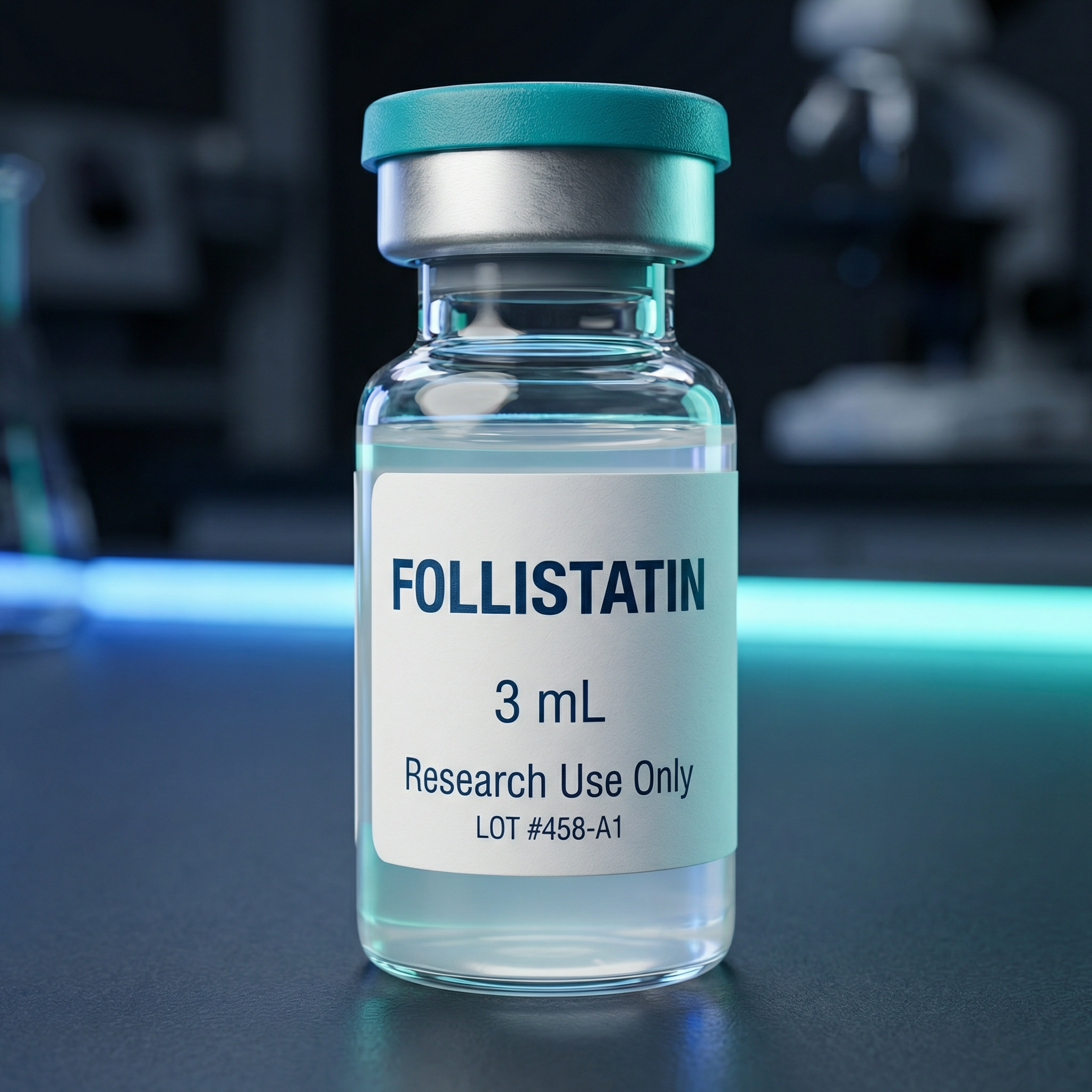
Follistatin is an endogenous regulatory glycoprotein that binds activins and myostatin-family ligands and is central to muscle-growth and reproductive biology. It is not a simple short peptide, yet it appears frequently in peptide-performance discussions because of its relationship to the myostatin pathway. In this repository it should be handled primarily as a pathway-biology and translational-therapy entry.
Standard names include follistatin and FST. The literature also references clinically relevant isoform concepts such as FS288, FS315, and FS344-based gene-delivery constructs, so the repository should preserve isoform context instead of treating "follistatin" as one uniform drug entity.
3. Sequence and structure
Human follistatin is a secreted cysteine-rich glycoprotein encoded as a 344 amino acid protein, with biologically relevant processed and isoform-dependent forms. Its structure and function are much more protein-like than peptide-like, involving ligand binding and extracellular regulatory activity rather than a short linear motif alone. Sequence length, isoform, and delivery modality are therefore all critical identity fields.
Follistatin acts as a binding antagonist for activins and can also neutralize myostatin / GDF-8 signaling, thereby altering SMAD-pathway activity and promoting muscle-growth biology in some contexts. The mechanism is biologically strong and well established at the pathway level. Therapeutic translation, however, depends heavily on how follistatin is delivered.
Research and development interest has focused on muscular dystrophy, inclusion body myositis, muscle-wasting states, fertility-related biology, and broader TGF-beta pathway modulation. Those should be labeled as investigational or translational use cases, not approved follistatin indications. The most credible human work has come through gene-therapy style delivery rather than ordinary peptide injection.
There is no single universal PK profile because follistatin appears in different biologic contexts, including endogenous protein, recombinant constructs, and viral gene-transfer strategies. Delivery modality is therefore inseparable from pharmacology. Repository fields should capture modality rather than forcing one simplified half-life number.
Pathway-level efficacy evidence is strong in animal studies, especially for muscle-mass effects. Human translational evidence exists in small early studies, including follistatin gene-therapy work in Becker muscular dystrophy and sporadic inclusion body myositis, but it remains too limited for broad therapeutic conclusions. Evidence strength is moderate for biologic effect and low to moderate for clinical proof.
Safety assessment must include both molecule-related and platform-related risk. Potential issues include unwanted reproductive or endocrine effects, excessive pathway blockade, off-target tissue effects, and vector-related concerns when gene therapy is used. Long-term safety is not settled.
No general-purpose approved follistatin dosing standard was identified. Future repository dosing fields should be modality-specific, especially distinguishing gene-transfer protocols from any recombinant-protein experimentation.
UNVERIFIED RESEARCHER-REPORTED DOSING INFORMATION
The following dosing information has been compiled from community forums, researcher discussions, and gray-market sources. This information has NOT been verified through peer-reviewed scientific studies or clinical trials. It does NOT constitute medical advice, a prescription, or a recommendation for human use.
This data is presented solely for informational and educational purposes to document what is commonly discussed in research communities. Dosing protocols may be inaccurate, dangerous, or based on anecdotal reports with no scientific validation. Individual responses vary significantly, and unregulated compounds carry inherent risks including contamination, mislabeling, and unknown side effects.
Always consult qualified medical professionals before making any health-related decisions. The repository maintainers assume no liability for the use or misuse of this information.
Researcher-Reported Dosing Protocols
Common Dose Range: 100-200 mcg per injection
Administration Route: Subcutaneous injection
Frequency: Once daily
Timing: Pre-workout
Schedule / Protocol: 10-30 day cycles
Dose Escalation: Some users may start at a lower dose (e.g., 50 mcg) and increase to 100-200 mcg. No specific titration protocol is commonly discussed.
Additional Notes: Follistatin 344 is often used in short cycles. Some sources mention longer cycles of 8-12 weeks, but shorter cycles of 10-30 days are more commonly reported. There are also reports of single high-dose injections, but this is less common.
This researcher-reported dosing information was compiled from unverified community sources and does not represent validated scientific or medical guidance.
Small early-stage human follistatin gene-therapy studies have been reported, particularly in muscle-disease settings, but there is no mature mainstream approved follistatin therapy. The database should tag this entry as translational with early clinical signals.
No FDA- or EMA-approved standalone follistatin therapeutic was identified. Best categorized as investigational / pathway-modulation biology.
13. References and source quality
Best sources include reviewed protein databases such as UniProt for the human protein, plus the Becker muscular dystrophy and inclusion body myositis follistatin gene-therapy studies and foundational preclinical AAV-follistatin work. Source quality is high for basic biology and moderate for clinical translation.
Follistatin should not be modeled as a simple lyophilized short peptide. Manufacturing and quality questions depend on whether the repository is describing endogenous protein, recombinant protein, or a gene-therapy construct, and those distinctions should be explicit in the data model.
Version 0.1 starter entry created March 14, 2026. Evidence basis for this draft: UniProt protein records, foundational AAV-follistatin preclinical studies, and early human gene-therapy publications.