GDF-8
Growth differentiation factor 8, also known as myostatin; target-biology entry rather than a standard administered peptide
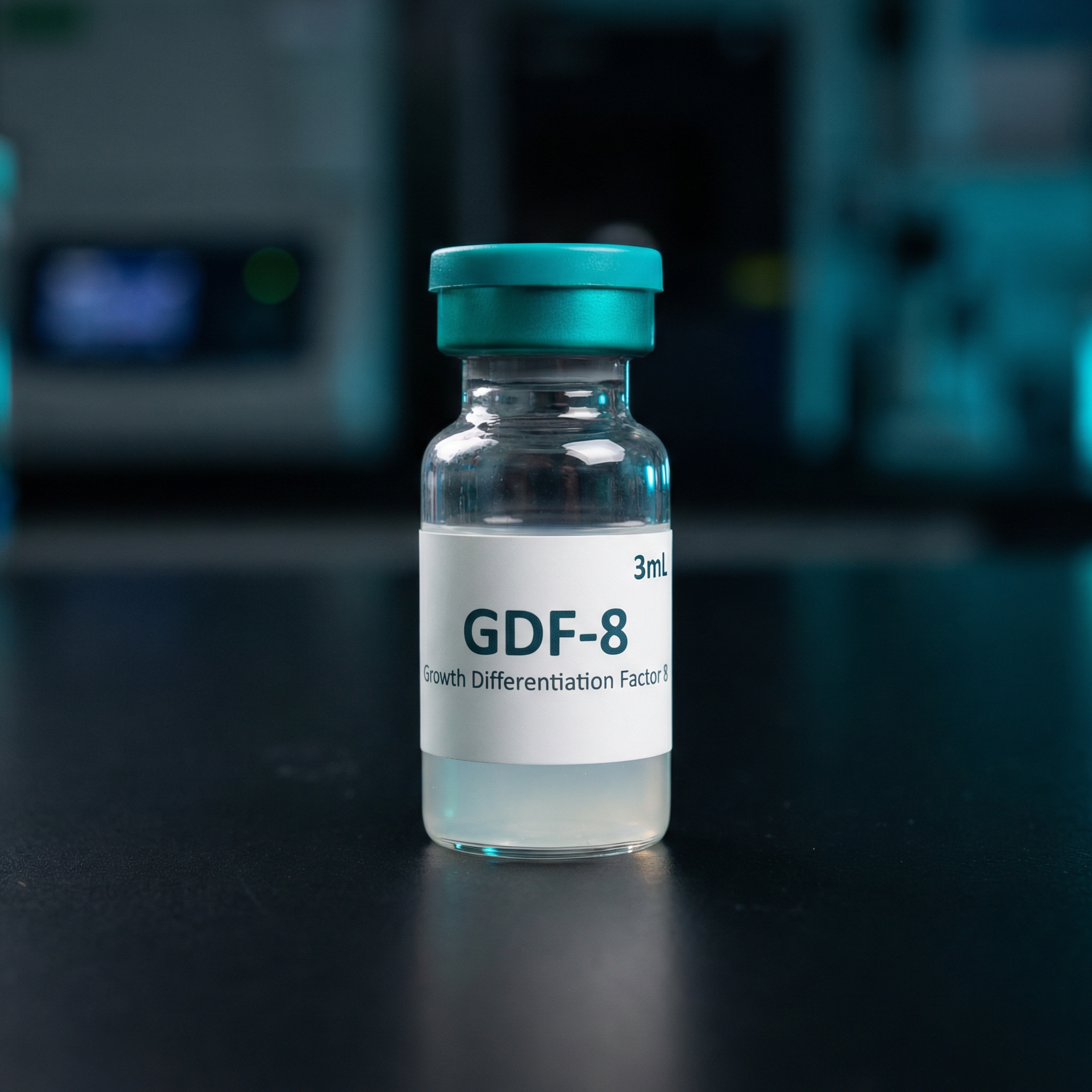
GDF-8, better known as myostatin, is an endogenous TGF-beta-family myokine that acts as a negative regulator of skeletal-muscle growth. It appears in peptide circles mostly because blocking GDF-8 is a major muscle-preservation strategy. This repository entry should therefore be treated mainly as target biology and pathway context, not as a common administered therapy.
Primary names include growth differentiation factor 8, GDF-8, and myostatin. The associated gene symbol is MSTN. Because many products and papers talk about "myostatin inhibitors" rather than GDF-8 itself, repository cross-links should map this record to blockers, traps, antibodies, and follistatin-axis entries.
3. Sequence and structure
Human GDF-8 is synthesized as a larger precursor protein of roughly 375 amino acids and processed into a mature bioactive dimeric growth factor. The active mature form behaves like a TGF-beta-family signaling ligand rather than a short linear peptide. For repository storage, precursor length and mature dimeric status matter more than listing a short commercial sequence.
Myostatin binds activin-type receptors and drives SMAD2/3 signaling that restrains muscle growth and affects broader metabolic and musculoskeletal biology. This mechanism is exceptionally well established. The therapeutic interest usually lies in inhibiting the pathway, not administering GDF-8 itself.
As a target, GDF-8 is relevant to muscle wasting, sarcopenia, obesity-body-composition research, rehabilitation, and inherited muscle conditions. As an administered molecule, however, it has little practical therapeutic role. The repository should therefore distinguish target biology from drug modality.
There is no ordinary approved clinical PK profile to present for GDF-8 itself. Pharmacology in therapeutic development is mostly discussed through inhibitors, ligand traps, antibodies, or pathway antagonists. Any future ADME fields should therefore probably live on blocker records rather than this target record.
The strongest evidence is target-validation evidence: suppressing myostatin signaling can increase muscle mass in animals and humans, though functional outcomes have been mixed across programs. That means the GDF-8 target is biologically compelling even when individual therapeutic programs succeed unevenly.
Safety questions mainly apply to pathway inhibition rather than endogenous GDF-8 itself. Concerns include disproportionate hypertrophy, tendon-muscle imbalance, metabolic effects, and off-target TGF-beta-family signaling consequences. Those risks should be attached to blocker strategies in downstream records.
No standard clinical dosing record should be created for GDF-8 itself in this starter entry. If the repository later tracks recombinant research reagents, those should be clearly separated from therapeutic-use fields.
UNVERIFIED RESEARCHER-REPORTED DOSING INFORMATION
The following dosing information has been compiled from community forums, researcher discussions, and gray-market sources. This information has NOT been verified through peer-reviewed scientific studies or clinical trials. It does NOT constitute medical advice, a prescription, or a recommendation for human use.
This data is presented solely for informational and educational purposes to document what is commonly discussed in research communities. Dosing protocols may be inaccurate, dangerous, or based on anecdotal reports with no scientific validation. Individual responses vary significantly, and unregulated compounds carry inherent risks including contamination, mislabeling, and unknown side effects.
Always consult qualified medical professionals before making any health-related decisions. The repository maintainers assume no liability for the use or misuse of this information.
Researcher-Reported Dosing Protocols
Common Dose Range: 1 mg per day
Administration Route: Subcutaneous or Intramuscular injection
Frequency: Every five days
Timing: Not specified in researcher-reported protocols.
Schedule / Protocol: 25-day cycle
Dose Escalation: No specific escalation protocol is commonly discussed. Researchers typically start with the intended dose.
Additional Notes: GDF-8 has a half-life of approximately 5 days. The information is based on community discussions and should not be considered medical advice.
This researcher-reported dosing information was compiled from unverified community sources and does not represent validated scientific or medical guidance.
Human clinical activity in this space has centered on GDF-8 inhibition or broader activin-pathway modulation, not on administering GDF-8. This record should therefore link outward to pathway-targeting programs rather than pretend there is a direct GDF-8 treatment program.
No approved GDF-8 agonist or recombinant myostatin therapy was identified. Best categorized as target biology with active therapeutic interest in antagonism.
13. References and source quality
Best sources include reviewed protein records for the human target, modern myostatin reviews, and recent translational studies showing muscle-preservation effects from GDF-8 or GDF-8/activin blockade. Source quality is high for pathway biology and variable for therapeutic generalization across programs.
As a research protein, GDF-8 is handled like a recombinant signaling factor rather than a short synthetic peptide. The repository should keep target entries distinct from product entries so manufacturing metadata does not become misleading.
Version 0.1 starter entry created March 14, 2026. Evidence basis for this draft: reviewed protein-database records for MSTN / GDF-8, modern myostatin reviews, and recent translational muscle-preservation studies.