GHK-Cu
Copper-complexed GHK tripeptide used mainly in topical skin and tissue-repair research
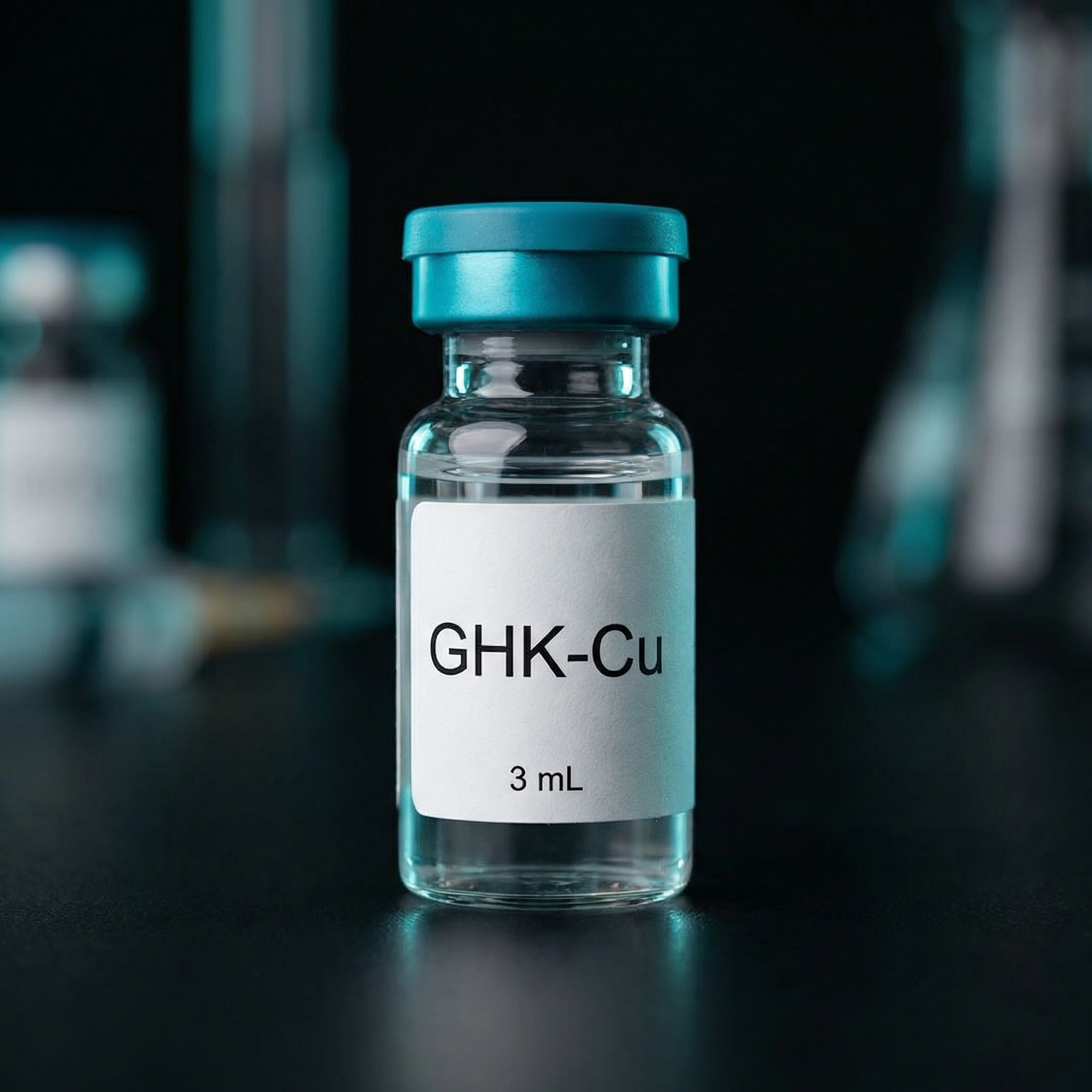
GHK-Cu is the copper-complexed form of the endogenous tripeptide GHK and is best known for skin-remodeling, wound-healing, and cosmetic-aging applications. It is one of the more credible peptide-adjacent cosmetic actives in this repository, but claims often outrun the evidence when moved into broad systemic anti-aging marketing. Best categorized as a topical / regenerative-research peptide complex rather than a proven systemic therapy.
Important names include GHK, glycyl-L-histidyl-L-lysine, GHK-Cu, copper tripeptide, and copper tripeptide-1 in cosmetic contexts. The repository should distinguish the peptide backbone from its copper complex because market naming can blur the two.
3. Sequence and structure
The parent peptide is the tripeptide Gly-His-Lys. The bioactive cosmetic and research form most often discussed is the copper(II) complex, which changes the physicochemical behavior and should therefore be treated as a distinct stored identity from plain GHK. This is a very small peptide system compared with protein hormones or long synthetic senolytics.
GHK-Cu is associated with tissue-remodeling biology, including collagen and extracellular-matrix support, anti-inflammatory signaling, antioxidant effects, and improved wound-repair responses in some models. It may also affect gene-expression programs linked to regeneration. Mechanistic confidence is moderate for skin and repair biology, but much lower for broad longevity claims.
The most defensible use cases are topical skin care, skin-repair support, wound-healing research, and possibly hair or scalp applications. Internet claims about injectable anti-aging, body recomposition, or full-system rejuvenation should be labeled as non-approved and weakly supported. This is a case where route matters enormously.
Topical behavior and local tissue activity are better supported than systemic PK. Formal ADME data for injectable or systemic use are limited, so the repository should avoid presenting a confident half-life or exposure model for those routes. For most practical purposes, GHK-Cu is a local-use or formulation-dependent compound.
Evidence for skin-remodeling and repair is better than for many trendy peptides, including controlled human and preclinical signals, but the literature is still heterogeneous and not equivalent to large drug-style trials. Evidence strength is moderate for topical tissue-support claims and low for sweeping anti-aging narratives.
Topical use is generally described as well tolerated, though irritation or formulation-specific reactions can occur. Safety becomes much less certain when compounded or injected outside regulated medical settings, where contamination, sterility, and dosing problems become the dominant risks. The repository should clearly separate topical-cosmetic safety from unregulated injectable risk.
Because most legitimate use is topical or formulation-dependent, universal dose lines are not especially helpful. If the repository later tracks products, route, concentration, and formulation base should be stored rather than a single generalized "dose".
UNVERIFIED RESEARCHER-REPORTED DOSING INFORMATION
The following dosing information has been compiled from community forums, researcher discussions, and gray-market sources. This information has NOT been verified through peer-reviewed scientific studies or clinical trials. It does NOT constitute medical advice, a prescription, or a recommendation for human use.
This data is presented solely for informational and educational purposes to document what is commonly discussed in research communities. Dosing protocols may be inaccurate, dangerous, or based on anecdotal reports with no scientific validation. Individual responses vary significantly, and unregulated compounds carry inherent risks including contamination, mislabeling, and unknown side effects.
Always consult qualified medical professionals before making any health-related decisions. The repository maintainers assume no liability for the use or misuse of this information.
Researcher-Reported Dosing Protocols
Common Dose Range: 1-2 mg per injection
Administration Route: Subcutaneous injection or topical application
Frequency: Once daily, often with a 5 days on / 2 days off schedule
Timing: No specific timing is consistently recommended, but a consistent time of day is advised.
Schedule / Protocol: 8-12 week cycles, followed by a 2-4 week break
Dose Escalation: A common approach is to start at 1.0 mg daily for the first 4 weeks, increase to 1.5 mg for weeks 5-8, and finally up to 2.0 mg for weeks 9-12.
Additional Notes: It is recommended to rotate injection sites to avoid local irritation. GHK-Cu is often sold as a research peptide.
This researcher-reported dosing information was compiled from unverified community sources and does not represent validated scientific or medical guidance.
Human evidence exists mainly in smaller wound-healing, skin-aging, and cosmetic-application studies rather than in a large late-stage drug-development program. The clinical picture is real but limited in scale and scope.
Used in cosmetic and personal-care contexts, but not identified as an FDA- or EMA-approved systemic drug product for the kinds of peptide-therapy claims often made online. Best coded as cosmetic / topical-active plus experimental regenerative peptide complex.
13. References and source quality
Highest-value sources include the major GHK and GHK-Cu reviews on tissue remodeling and regeneration, newer topical anti-wrinkle reviews, and PubChem compound records for structure metadata. Source quality is moderate to high for skin and repair biology, and low for gray-market injectable claims.
Formulation matters a great deal because copper coordination, pH, carrier base, and stability can change behavior. Repository fields should capture whether the record is plain GHK, GHK-Cu, acetate or other salt, and whether the intended route is topical, local, or experimental systemic use.
Version 0.1 starter entry created March 14, 2026. Evidence basis for this draft: PubChem compound data, major GHK/GHK-Cu review literature, and recent topical anti-wrinkle reviews.