LL37
Human cathelicidin antimicrobial peptide (LL-37); innate-immunity and wound-healing peptide with real clinical investigation but no broad approval
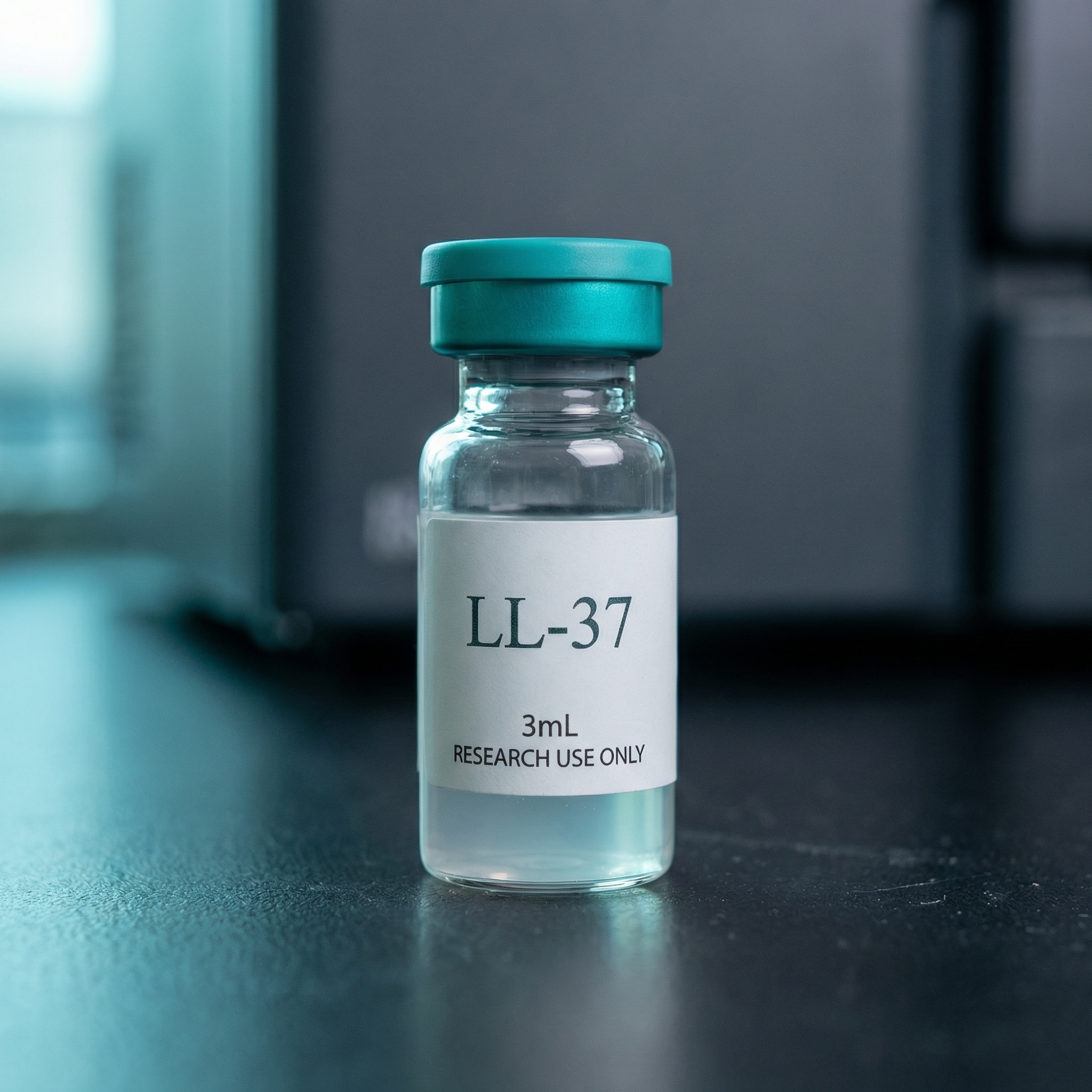
LL-37 is the only human cathelicidin antimicrobial peptide and is one of the more biologically serious entries in this repository. It plays roles in host defense, immune modulation, biofilm biology, and tissue repair, and synthetic LL-37 formulations have advanced into human wound-healing trials. The repository should classify it as a legitimate endogenous host-defense peptide with translational potential, while still noting that broad approved therapeutic use has not been established.
Standard names include LL-37, human cathelicidin antimicrobial peptide, CAP18-derived peptide, and the development name ropocamptide in some clinical contexts. Because the literature includes many analogs and modified cathelicidin fragments, the database should preserve the exact peptide identity and distinguish native LL-37 from engineered derivatives.
3. Sequence and structure
LL-37 is a 37-amino-acid cationic linear peptide with the sequence LLGDFFRKSKEKIGKEFKRIVQRIKDFLRNLVPRTES. It is the C-terminal active peptide derived from the human cathelicidin precursor hCAP18 and is typically discussed as an amphipathic alpha-helical host-defense peptide. Sequence integrity matters because even small modifications can change antimicrobial, immunologic, and membrane-active behavior.
LL-37 has multifaceted biology: direct antimicrobial and anti-biofilm effects, immunomodulatory signaling, chemotactic and wound-healing actions, and context-dependent pro- or anti-inflammatory behavior. It does not fit a simple one-receptor pharmacology model, which is why its mechanism section should be broader than for single-target agonist peptides. Mechanistic confidence is high for innate-immune relevance but more distributed across pathways than for classic endocrine peptides.
Most defensible use cases are research and clinical investigation in wound healing, infected wounds, biofilm control, and innate-immunity biology. Public claims about broad antiviral, anti-cancer, or injectable rejuvenation use should be treated very cautiously and labeled as non-approved or highly context-dependent. The cleanest translational path has been topical wound-related use.
For therapeutic development, LL-37 is largely a local-delivery story rather than a settled systemic PK story. Peptide instability, tissue exposure, formulation constraints, and membrane interactions all matter, which is why topical and local wound applications have attracted more serious development attention than generalized systemic dosing. The repository should emphasize route-dependent behavior.
Preclinical evidence for antimicrobial, anti-biofilm, and wound-healing effects is strong. Human efficacy evidence is more selective but real, including randomized clinical evaluation in hard-to-heal venous leg ulcers with ropocamptide / LL-37 formulations. This should be scored as stronger than many speculative peptides, though still short of broad standard-of-care status.
Safety depends heavily on route and local concentration because host-defense peptides can also perturb membranes and inflammatory signaling. Clinical wound studies provide useful human tolerability information, but that does not automatically generalize to unregulated systemic or cosmetic use. The repository should flag concentration-dependent local reactions and formulation-specific risk.
No broad approved dosing framework exists. Any future dose entries should clearly identify whether the context is topical gel, wound application, local delivery system, or a research-only experimental route.
UNVERIFIED RESEARCHER-REPORTED DOSING INFORMATION
The following dosing information has been compiled from community forums, researcher discussions, and gray-market sources. This information has NOT been verified through peer-reviewed scientific studies or clinical trials. It does NOT constitute medical advice, a prescription, or a recommendation for human use.
This data is presented solely for informational and educational purposes to document what is commonly discussed in research communities. Dosing protocols may be inaccurate, dangerous, or based on anecdotal reports with no scientific validation. Individual responses vary significantly, and unregulated compounds carry inherent risks including contamination, mislabeling, and unknown side effects.
Always consult qualified medical professionals before making any health-related decisions. The repository maintainers assume no liability for the use or misuse of this information.
Researcher-Reported Dosing Protocols
Common Dose Range: 100-400 mcg per day via injection. For topical application on wounds, 0.5-1.6 mg/mL has been reported.
Administration Route: Subcutaneous injection is the most common route. Topical application is also reported for wound healing.
Frequency: Once daily. Some protocols suggest a 5-days-on, 2-days-off schedule.
Timing: Can be taken at any consistent time of day. For gut-related purposes, administration on an empty stomach is sometimes mentioned.
Schedule / Protocol: Reported cycle lengths vary, ranging from 2-4 week cycles with at least 2 weeks off, to longer 8-12 week cycles (extendable to 16 weeks).
Dose Escalation: It is commonly recommended to start with a lower dose of 50-100 mcg daily and gradually increase the dosage over several weeks. One source suggests increasing by approximately 50 mcg each week, while another suggests starting with 100 mcg for 3-5 days before increasing if well-tolerated.
Additional Notes: Reconstitute with bacteriostatic water and keep refrigerated. It is advised to rotate injection sites to avoid localized redness or burning.
This researcher-reported dosing information was compiled from unverified community sources and does not represent validated scientific or medical guidance.
LL-37 has entered human clinical testing, especially in wound-healing indications such as venous leg ulcers, which gives it more translational depth than many entries in this document. Even so, no broadly approved LL-37 drug product was identified in this review.
Not identified as an FDA- or EMA-approved mainstream therapeutic product. Best categorized as an endogenous human host-defense peptide with active translational and clinical-development history.
13. References and source quality
Highest-value sources include PubChem compound records, major reviews on LL-37 biology, and clinical-study publications on wound-healing applications such as ropocamptide in venous leg ulcers. Source quality is high for sequence and innate-immunity biology and moderate for product-development outcomes.
Key quality fields include peptide purity, aggregation profile, salt form, formulation base, and whether the record is native LL-37 or a modified analog. Because biologic effects are highly concentration- and formulation-sensitive, manufacturing metadata should be more detailed than for many simple peptides.
Version 0.1 starter entry created March 14, 2026. Evidence basis for this draft: PubChem identity data, major LL-37 review literature, and randomized clinical-study reporting in wound-healing applications.