Melanotan 1 (MT-1)
Afamelanotide / Melanotan-1 analog of alpha-MSH; approved medicine under the afamelanotide name but often confused with gray-market tanning products
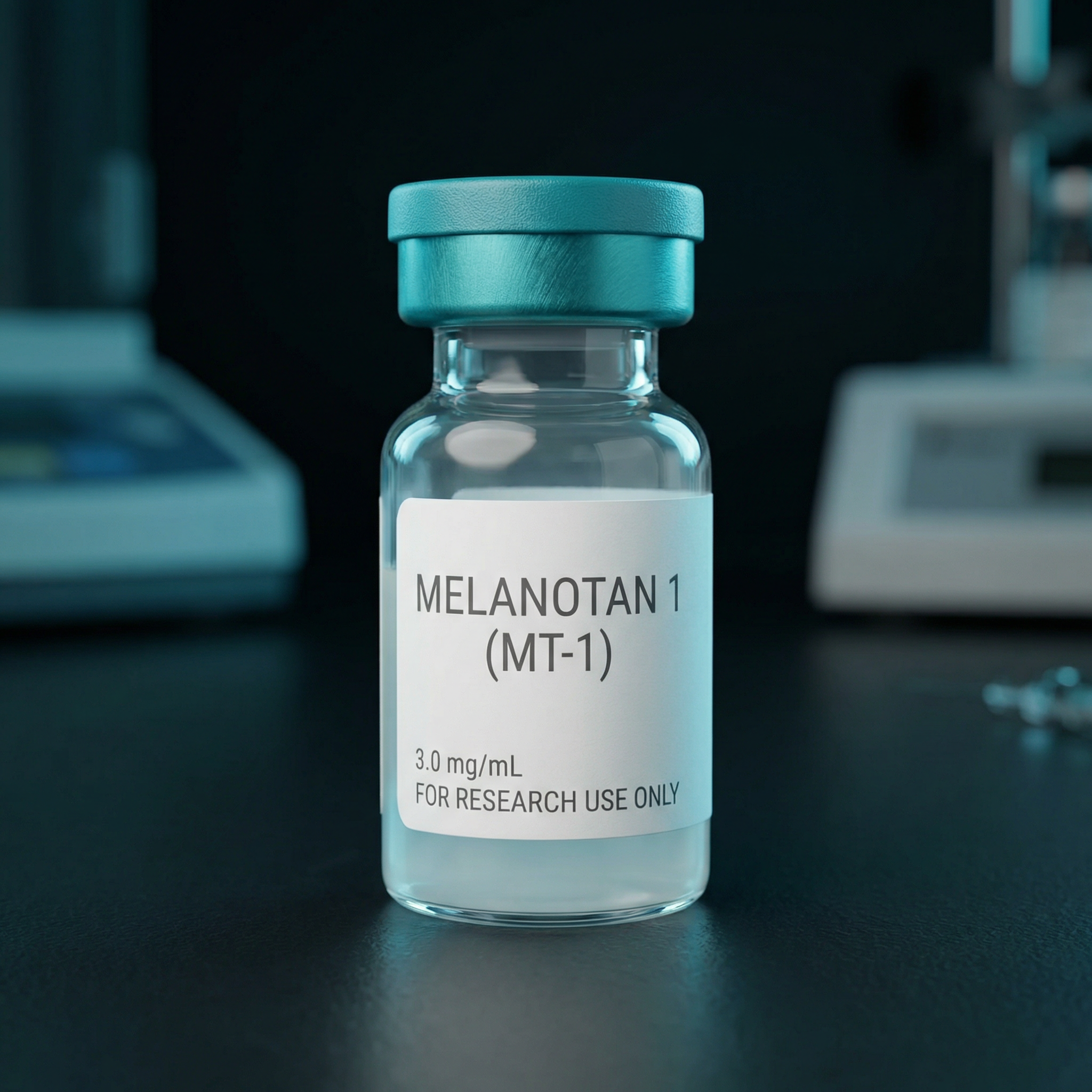
Melanotan 1 is best understood in serious biomedical contexts as afamelanotide, an alpha-MSH analog with real regulatory approval history. That is important because online discussion often mixes legitimate afamelanotide / SCENESSE information with unregulated tanning-peptide culture. The repository should cleanly separate the approved medical product from gray-market MT-1 branding and note that this entry belongs partly in the approved-drug tier.
Key names include Melanotan 1, MT-1, afamelanotide, SCENESSE, CUV1647, and [Nle4, D-Phe7]-alpha-MSH. The identity section should make afamelanotide the preferred regulated synonym and treat casual Melanotan 1 naming as an alias that may blur approved and non-approved product channels. This distinction is central to repository accuracy.
3. Sequence and structure
Afamelanotide is a linear 13-amino-acid alpha-MSH analog with the sequence Ac-Ser-Tyr-Ser-Nle-Glu-His-D-Phe-Arg-Trp-Gly-Lys-Pro-Val-NH2. The two classic modifications versus native alpha-MSH are norleucine at position 4 and D-phenylalanine at position 7, which improve potency and stability. The amidated C terminus and N-terminal acetylation should be stored explicitly.
Afamelanotide is primarily a melanocortin-1 receptor agonist that stimulates eumelanin production and enhances photoprotection in relevant tissues. Its biology is therefore more specific and clinically validated than generic tanning narratives suggest. Mechanistic confidence is high.
The evidence-based approved use is to increase pain-free light exposure in adults with a history of phototoxic reactions from erythropoietic protoporphyria. Cosmetic tanning or unregulated skin-darkening use should not be conflated with this approved medical indication. The repository should keep those paths sharply separated.
Afamelanotide is used as a controlled implant product in regulated medicine, which means its practical pharmacology reflects depot delivery and sustained exposure rather than simple short-peptide kinetics. That product context matters more than trying to summarize it as a generic injectable peptide.
Efficacy evidence is clinically meaningful and approval-supporting in erythropoietic protoporphyria, where trials demonstrated increases in pain-free light exposure and related benefit. That evidence is much stronger than the informal cosmetic-tanning narratives attached to the Melanotan name. The repository should score approved-indication efficacy as high.
Safety is characterized through regulatory review and post-marketing use, with common considerations including implant-site effects, pigmentary changes, and product-specific tolerability issues. Those data are far more reliable than anecdotal reports from non-medical tanning use. The database should emphasize approved-product safety over gray-market narratives.
Dosing should be recorded according to the approved implant-based product framework rather than as a generic peptide injection line. Route and device are essential parts of this entry.
UNVERIFIED RESEARCHER-REPORTED DOSING INFORMATION
The following dosing information has been compiled from community forums, researcher discussions, and gray-market sources. This information has NOT been verified through peer-reviewed scientific studies or clinical trials. It does NOT constitute medical advice, a prescription, or a recommendation for human use.
This data is presented solely for informational and educational purposes to document what is commonly discussed in research communities. Dosing protocols may be inaccurate, dangerous, or based on anecdotal reports with no scientific validation. Individual responses vary significantly, and unregulated compounds carry inherent risks including contamination, mislabeling, and unknown side effects.
Always consult qualified medical professionals before making any health-related decisions. The repository maintainers assume no liability for the use or misuse of this information.
Researcher-Reported Dosing Protocols
Common Dose Range: 250-1000 mcg per injection
Administration Route: Subcutaneous injection
Frequency: Once daily during initial loading phase, then 1-3x per week for maintenance.
Timing: Often administered prior to anticipated UV exposure to maximize effects.
Schedule / Protocol: Typically a 7-10 day loading phase, followed by a longer-term maintenance phase.
Dose Escalation: It is commonly recommended to start with a lower dose (e.g., 250 mcg) to assess individual tolerance before titrating up to a full dose.
Additional Notes: The dosing information provided is for research purposes. It is important to distinguish this from the FDA-approved medical use of afamelanotide (Scenesse), which is a 16mg subcutaneous implant administered every 2 months for the treatment of erythropoietic protoporphyria (EPP). Researcher protocols often involve a 'loading' phase with more frequent injections to build up melanin, followed by a 'maintenance' phase with less frequent injections to maintain the desired level of pigmentation.
This researcher-reported dosing information was compiled from unverified community sources and does not represent validated scientific or medical guidance.
Afamelanotide has completed the clinical-development and approval path for erythropoietic protoporphyria and therefore has a mature clinical-trial foundation relative to many entries in this repository. Trial metadata should center on the approved disease context.
Approved in Europe and the United States under the afamelanotide / SCENESSE identity for erythropoietic protoporphyria-related phototoxicity management. Any non-approved tanning use should be tagged separately as outside the regulated indication.
13. References and source quality
Highest-value sources include FDA labeling and review documents for SCENESSE, PubChem chemistry records for afamelanotide, and dermatology references summarizing the EPP approval experience. Source quality is high for mechanism, sequence identity, and approved use.
The repository should capture implant product details, peptide modifications, stability, and sponsor-grade quality controls. Because name confusion is common, manufacturing and product-presentation metadata help prevent accidental merging with non-approved Melanotan materials.
Version 0.1 starter entry created March 14, 2026. Evidence basis for this draft: FDA labeling and review documents for SCENESSE, PubChem afamelanotide metadata, and dermatology review literature.