Melanotan 2 Acetate
Synthetic cyclic melanocortin analog associated with tanning and sexual-function claims; not an approved mainstream medicine
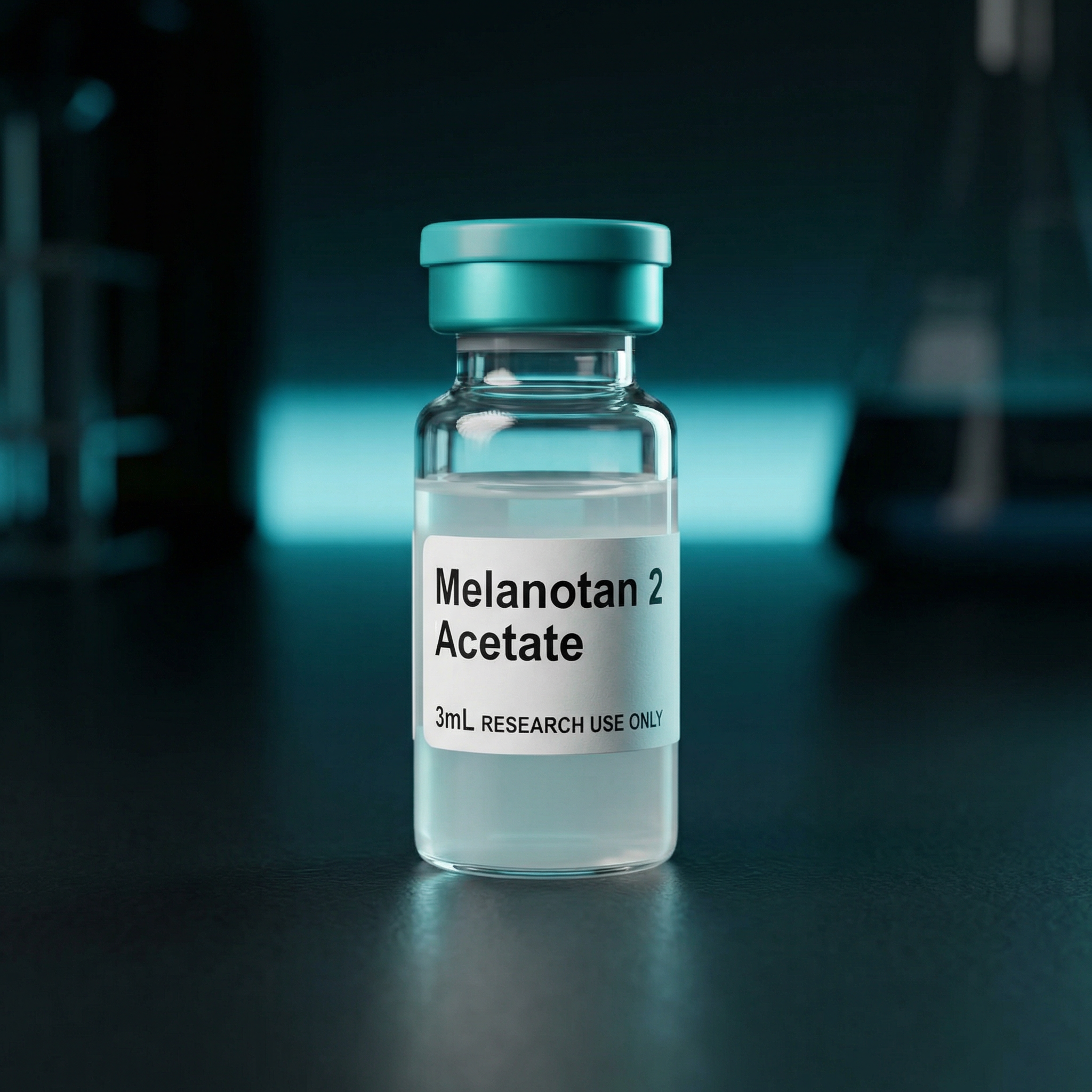
Melanotan 2 is a synthetic melanocortin analog best known from gray-market tanning and sexual-function narratives. Unlike afamelanotide / MT-1, it does not have a broad mainstream approved therapeutic identity and should be treated as a non-approved synthetic research / gray-market peptide. The repository should reflect its real receptor pharmacology without implying that it is a validated clinical therapy.
Relevant names include Melanotan 2, MT-2, melanotan-II, and salt-form identifiers such as melanotan-II acetate. The entry should distinguish it from Melanotan 1 / afamelanotide and from bremelanotide, which is a separate melanocortin-related drug with an actual approved use case. Name confusion is common and should be managed explicitly.
3. Sequence and structure
Melanotan 2 is a synthetic cyclic heptapeptide analog typically described as Ac-Nle-cyclo[Asp-His-D-Phe-Arg-Trp-Lys]-NH2. Its cyclization and nonnatural residue pattern are central to its activity and should be recorded directly, with acetate captured as a salt-form detail rather than part of the core sequence. This is a designed melanocortin analog, not a native human peptide.
Melanotan 2 is a melanocortin receptor agonist with activity across multiple receptor subtypes, driving melanogenesis and other melanocortin-related effects that help explain both tanning and sexual-response claims. The biology is real, but it is not cleanly selective in the way a narrowly targeted approved drug would ideally be. Mechanistic confidence is high; clinical appropriateness is a separate question.
In practice, most use claims revolve around tanning, pigment change, appetite effects, and sexual-function narratives. Those are not equivalent to approved mainstream indications for MT-2 itself. The repository should mark the compound as non-approved and keep any discussion of related approved melanocortin drugs in a separate comparison field.
Formal pharmacokinetic characterization exists to some extent in the development literature around melanocortin agonists, but the real-world use environment for MT-2 is dominated by non-approved compounded or gray-market product exposure. Practical interpretation should therefore emphasize that pharmacology is plausible while product quality and route consistency are major uncertainties.
The compound clearly has biologic effects on pigmentation and related melanocortin endpoints, which is why it persists in gray markets. What it lacks is a clean mainstream evidence-and-approval package supporting routine medical use as MT-2. The repository should therefore score endpoint activity higher than therapeutic validation.
Common concerns discussed around melanocortin agonists include nausea, flushing, appetite effects, pigmentary changes, and broader uncertainty around unregulated long-term use. Product-quality and contamination risks are especially relevant because much real-world use occurs outside regulated supply chains. This entry should be presented as pharmacologically active but clinically undercontrolled.
No approved therapeutic dosing framework should be displayed. Any future dose information should be attached to specific research contexts and not normalized into a clinic-style regimen.
UNVERIFIED RESEARCHER-REPORTED DOSING INFORMATION
The following dosing information has been compiled from community forums, researcher discussions, and gray-market sources. This information has NOT been verified through peer-reviewed scientific studies or clinical trials. It does NOT constitute medical advice, a prescription, or a recommendation for human use.
This data is presented solely for informational and educational purposes to document what is commonly discussed in research communities. Dosing protocols may be inaccurate, dangerous, or based on anecdotal reports with no scientific validation. Individual responses vary significantly, and unregulated compounds carry inherent risks including contamination, mislabeling, and unknown side effects.
Always consult qualified medical professionals before making any health-related decisions. The repository maintainers assume no liability for the use or misuse of this information.
Researcher-Reported Dosing Protocols
Common Dose Range: 250-500 mcg per injection
Administration Route: Subcutaneous injection
Frequency: Once daily, sometimes 3-4 times per week or every other day
Timing: Typically before bed to minimize side effects, or 45-60 minutes prior to sun exposure.
Schedule / Protocol: 14-day initial cycle, followed by a maintenance phase
Dose Escalation: It is commonly recommended to start with a lower dose (100-250 mcg) to assess tolerance and mitigate side effects like nausea, then gradually titrate up to the desired dosage.
Additional Notes: For erectile dysfunction, a higher dose of 1-2mg is sometimes used on an as-needed basis. Common side effects include nausea, flushing, yawning, and darkening of moles.
This researcher-reported dosing information was compiled from unverified community sources and does not represent validated scientific or medical guidance.
Melanotan 2 has developmental and research history, but a broad regulated therapeutic pathway was not identified for the parent compound in this review. The repository should code it as clinically explored / non-approved.
Not identified as an FDA- or EMA-approved mainstream medicine as Melanotan 2. Best categorized as a non-approved melanocortin agonist with gray-market use.
13. References and source quality
Core sources include PubChem chemistry records, melanocortin review literature, and historical development sources that contextualize related compounds such as bremelanotide. Source quality is high for structure and receptor biology and lower for real-world use claims.
Important fields include cyclization, sequence integrity, salt form, purity, and analytical differentiation from related melanocortin peptides. Mislabeling against MT-1 or other melanocortin analogs is a realistic quality-control risk.
Version 0.1 starter entry created March 14, 2026. Evidence basis for this draft: PubChem records for melanotan-II, melanocortin review literature, and historical development context for related melanocortin agonists.