NAD+
Endogenous redox coenzyme and dinucleotide; not actually a peptide, but commonly grouped with peptide and longevity catalogs because of IV / IM wellness-market use and mitochondrial-aging narratives.
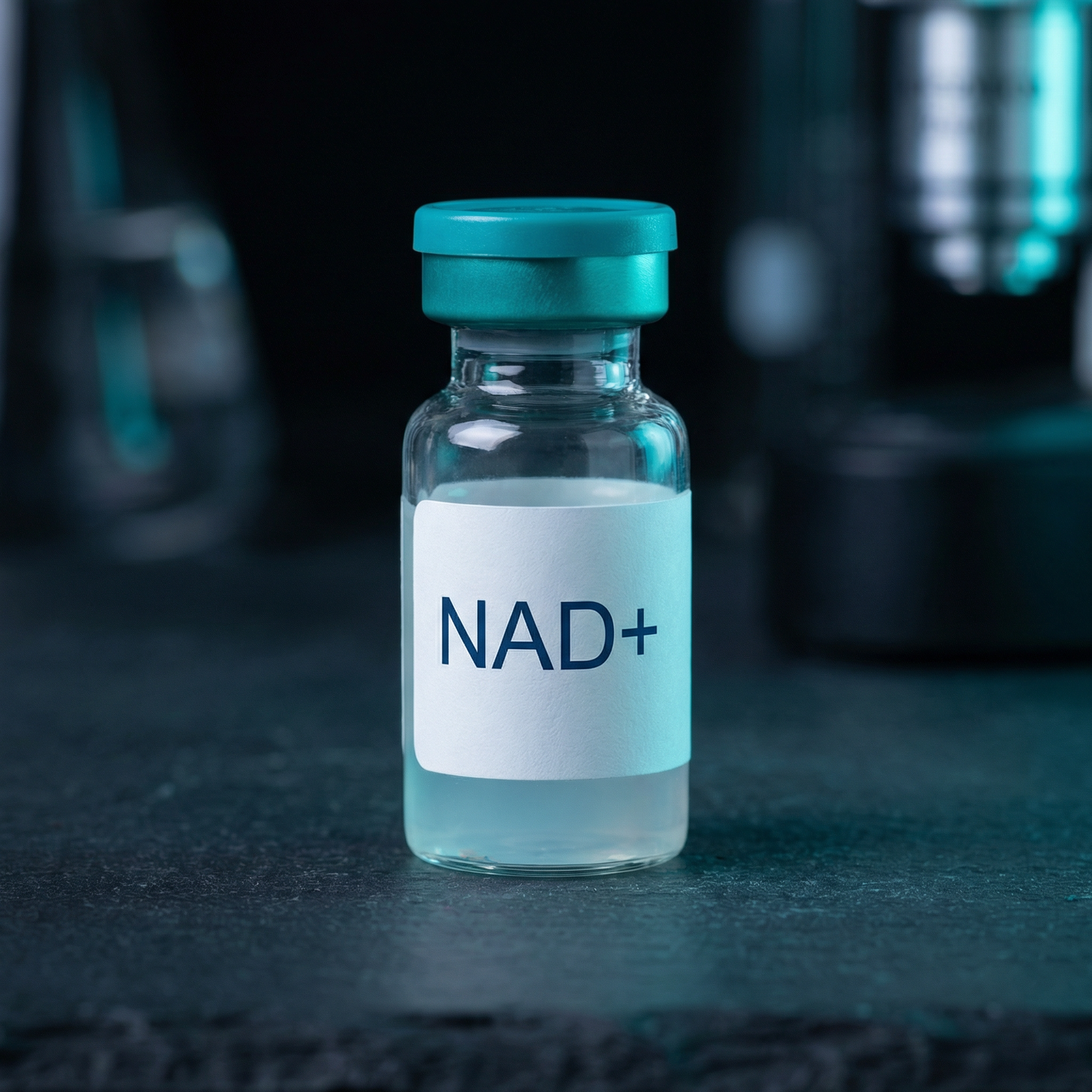
NAD+ is not a peptide. It is the oxidized form of nicotinamide adenine dinucleotide, a core redox coenzyme involved in cellular energy metabolism, signaling, DNA repair biology, and substrate-level interactions with enzymes such as sirtuins, PARPs, and CD38. It appears in peptide-adjacent databases because of longevity, biohacking, and infusion-clinic interest, but its scientific and regulatory profile is very different from that of a peptide therapeutic.
Important names include NAD+, nicotinamide adenine dinucleotide, beta-NAD, and oxidized nicotinamide adenine dinucleotide. The repository should distinguish NAD+ from NADH, nicotinamide riboside, NMN, niacin, and compounded injection-brand shorthand. Because popular discussion often blurs these together, the identity section should explicitly note that NAD+ itself is the coenzyme, while many consumer products are precursors or compounded preparations rather than standardized approved drugs.
3. Sequence and structure
NAD+ has no amino-acid sequence because it is not a peptide. Structurally it is a dinucleotide composed of adenine and nicotinamide ribosides linked through phosphate groups. Section 3 for this entry should therefore focus on small-molecule identity, redox state, molecular formula, and relationship to NADH rather than peptide-sequence fields.
NAD+ acts as a central redox carrier in metabolism and also serves as a substrate for enzyme systems involved in DNA repair, cellular stress responses, calcium signaling, and chromatin-regulatory biology. This makes it biologically important, but it also means that simplistic clinical claims often oversell what direct NAD+ administration has actually been shown to do in humans. The repository should keep core biochemistry separate from speculative wellness language.
NAD+ has no mainstream FDA-approved indication as a finished drug product in the United States. Research and wellness-market use cases include fatigue, addiction-recovery adjunct settings, neuroprotection, healthy aging, metabolic support, and mitochondrial function. These should all be labeled investigational, off-label, compounded, or consumer-market claims rather than approved therapeutic uses.
Direct NAD+ pharmacology depends heavily on route and formulation. Infusion-clinic narratives often center on IV administration, while compounded products may be delivered by IM or SC injection, but there is no single standardized therapeutic PK framework that matches an approved branded medicine. Extracellular NAD+ is also entangled with metabolism into related intermediates and signaling consequences, so simple dose-response assumptions are often misleading.
The evidence base for direct exogenous NAD+ administration is much thinner than the enthusiasm around it. Biological plausibility is strong because NAD+ is fundamental to cell metabolism, but well-controlled clinical outcome evidence for direct NAD+ injections or infusions remains limited and heterogeneous. Stronger translational evidence often exists for pathway biology or precursor manipulation than for direct NAD+ wellness protocols.
Safety needs to be framed with unusual care because many real-world exposures involve compounded sterile preparations rather than FDA-approved finished drug products. Public FDA communications have noted adverse-event reports involving compounded NAD+ injectable drugs and quality concerns such as endotoxin-related reactions. Infusion intolerance, chills, nausea, and formulation-quality variability should therefore be captured explicitly.
There is no single approved dosing standard to display. If dose data are stored, they should be route-specific, preparation-specific, and tied to a defined protocol or source, with clear labeling that the regimen is compounded / investigational rather than an approved therapeutic schedule. For this entry, the repository is better served by provenance and formulation metadata than by a generic dose line.
UNVERIFIED RESEARCHER-REPORTED DOSING INFORMATION
The following dosing information has been compiled from community forums, researcher discussions, and gray-market sources. This information has NOT been verified through peer-reviewed scientific studies or clinical trials. It does NOT constitute medical advice, a prescription, or a recommendation for human use.
This data is presented solely for informational and educational purposes to document what is commonly discussed in research communities. Dosing protocols may be inaccurate, dangerous, or based on anecdotal reports with no scientific validation. Individual responses vary significantly, and unregulated compounds carry inherent risks including contamination, mislabeling, and unknown side effects.
Always consult qualified medical professionals before making any health-related decisions. The repository maintainers assume no liability for the use or misuse of this information.
Researcher-Reported Dosing Protocols
Common Dose Range: IV: 250-1500mg per infusion; Subcutaneous: 30-200mg per injection; Intramuscular: 50mg per injection; Oral (precursors): 250-900mg; Intranasal: 75-120mg
Administration Route: Intravenous, Subcutaneous, Intramuscular, Oral (as precursors), Intranasal, Topical, Sublingual
Frequency: IV: Weekly to monthly; Subcutaneous: Daily or 2-3 times per week; Intramuscular: Up to 3 times per week; Oral: Once or twice daily; Intranasal: Daily or twice daily
Timing: Oral doses are often split between morning and evening.
Schedule / Protocol: IV protocols may involve a loading phase of daily infusions for several days, followed by a tapered schedule. Subcutaneous protocols often follow a '5 days on / 2 days off' schedule after an initial daily period. Oral administration is typically continuous.
Dose Escalation: For subcutaneous injections, a common protocol is to start with a lower dose (e.g., 30mg daily) for the first week and then increase to a higher dose (e.g., 50mg) if desired.
Additional Notes: Oral administration of NAD+ itself is generally considered to have poor bioavailability. Researchers more commonly use NAD+ precursors like Nicotinamide Mononucleotide (NMN) or Nicotinamide Riboside (NR) for oral dosing. Intravenous (IV) infusions are typically administered over 2-4 hours. Dosing is highly individualized and depends on the specific research goals and protocols.
This researcher-reported dosing information was compiled from unverified community sources and does not represent validated scientific or medical guidance.
Human study activity exists, but not as a mature modern branded-drug development program leading to broad regulatory approval for NAD+ itself. Trials and pilot studies have appeared in diverse settings, but the evidence base is fragmented and often small. The repository should summarize clinical activity by indication cluster rather than implying a single coherent development pathway.
No U.S. FDA-approved finished drug product containing NAD+ for a standard indication was identified in this review. NAD+ injectable preparations encountered in practice are typically compounded and are not reviewed by FDA for safety or effectiveness as approved drugs. Regulatory status should therefore be recorded as non-approved / compounded / investigational depending on the exact product context.
13. References and source quality
Highest-value sources include basic-science and clinical reviews on NAD biology, public FDA communications on compounded NAD+ injectables, and reputable pharmacology references that distinguish NAD+ from its precursors. Clinic-marketing and wellness-vendor pages should be treated as low-confidence sources suitable mainly for documenting market claims, not efficacy conclusions.
Manufacturing fields should emphasize compounded-sterile context, supplier quality systems, endotoxin controls, route of administration, concentration, diluent, and storage conditions. Because NAD+ entries often get mixed with oral precursor products in user discussions, the repository should require explicit formulation labeling so NAD+, NADH, NMN, and NR products do not become conflated.
Version 0.1 starter entry created March 14, 2026. Evidence basis for this draft: core NAD biology literature and public FDA safety communications regarding compounded NAD+ injectables. Confidence level: high that NAD+ is not a peptide and not an FDA-approved finished drug product; lower for consumer-market efficacy claims.