PT-141
PT-141 is the development and market shorthand for bremelanotide, a cyclic melanocortin agonist approved in the United States as Vyleesi for acquired generalized hypoactive sexual desire disorder in premenopausal women.
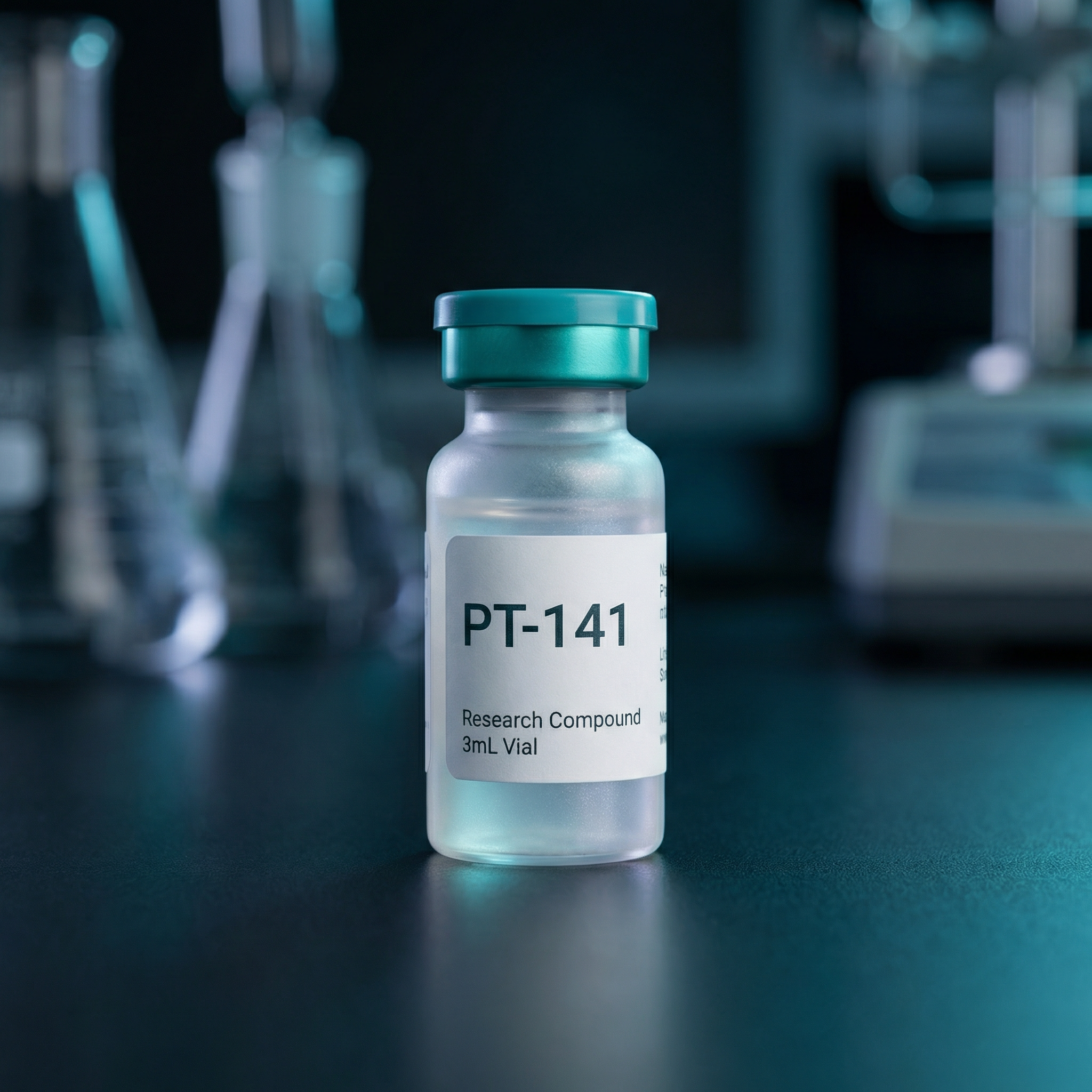
PT-141 is best understood as bremelanotide, a synthetic melanocortin agonist with a real FDA-approved product identity rather than a purely gray-market peptide. In practice, however, the PT-141 name is also used broadly in peptide-market settings, which is why the repository should anchor the record to the approved bremelanotide / Vyleesi framework first and treat gray-market naming as secondary.
Key names include PT-141, bremelanotide, bremelanotide acetate, and the brand Vyleesi. The identity section should explicitly distinguish PT-141 / bremelanotide from melanotan II, while also noting the close medicinal-chemistry relationship between them. Because peptide-market discussions often blur these compounds together, clear identity handling is essential.
3. Sequence and structure
Bremelanotide is a cyclic heptapeptide melanocortin analog commonly described as Ac-Nle-cyclo[Asp-His-D-Phe-Arg-Trp-Lys]-OH. It is structurally related to melanotan II and is often described as an active metabolite / derivative in that family. Section 3 should capture the cyclic architecture and melanocortin-analog lineage because those features explain both receptor biology and product confusion.
Bremelanotide acts as a melanocortin receptor agonist with central nervous system effects relevant to sexual desire pathways. The exact translation from receptor activation to clinical benefit is not fully simplified into one receptor subtype, but the melanocortin-system mechanism is well established. This entry should therefore emphasize central neuroendocrine signaling rather than peripheral vasodilator-type explanations.
The core approved indication is acquired generalized hypoactive sexual desire disorder in premenopausal women. Historical and off-label discussion has also touched erectile-dysfunction and broader sexual-function contexts, but the evidence-supported approved identity is the HSDD indication. Any non-approved use cases should be labeled separately.
PT-141 / bremelanotide is administered subcutaneously and has a conventional branded-drug pharmacology profile rather than an undefined research-peptide one. It achieves systemic exposure quickly enough for as-needed use, and its pharmacology is tied to melanocortin receptor agonism, peptide hydrolysis, and product-specific labeling constraints. PK fields should be drawn from approved-product sources, not market folklore.
Efficacy is real but should be described soberly: the approved program demonstrated statistically significant benefit for desire and distress outcomes in the labeled population, while not all secondary endpoints were dramatic. This is not a miracle-effect medicine, but it is a legitimate approved peptide drug with clinically meaningful benefit in a defined subgroup.
The safety profile includes prominent nausea, transient increases in blood pressure, reductions in heart rate after dosing, and hyperpigmentation / gum darkening risks with repeated use. It is not intended for frequent continuous dosing, which is why the label imposes use-frequency limits. These practical safety constraints should be easy to see in the repository.
Approved dosing is 1.75 mg by subcutaneous injection as needed before anticipated sexual activity, with no more than one dose within 24 hours and no more than eight doses per month. This is one of the entries where a concrete approved regimen should be stored because the product is a real branded medicine.
UNVERIFIED RESEARCHER-REPORTED DOSING INFORMATION
The following dosing information has been compiled from community forums, researcher discussions, and gray-market sources. This information has NOT been verified through peer-reviewed scientific studies or clinical trials. It does NOT constitute medical advice, a prescription, or a recommendation for human use.
This data is presented solely for informational and educational purposes to document what is commonly discussed in research communities. Dosing protocols may be inaccurate, dangerous, or based on anecdotal reports with no scientific validation. Individual responses vary significantly, and unregulated compounds carry inherent risks including contamination, mislabeling, and unknown side effects.
Always consult qualified medical professionals before making any health-related decisions. The repository maintainers assume no liability for the use or misuse of this information.
Researcher-Reported Dosing Protocols
Common Dose Range: 1-2 mg per injection
Administration Route: Subcutaneous injection, Intranasal, or Oral tablet
Frequency: As needed, up to twice weekly
Timing: 1-2 hours before sexual activity
Schedule / Protocol: Not applicable
Dose Escalation: It is commonly recommended to start with a test dose of 1mg. If no adverse effects are experienced, an additional 1mg may be taken. The dose can be titrated up to a maximum of 2mg within a 72-hour period.
Additional Notes: The effects of PT-141 can last from 24 to 72 hours. While subcutaneous injection is a common route, intranasal and oral tablet forms are also available.
This researcher-reported dosing information was compiled from unverified community sources and does not represent validated scientific or medical guidance.
Clinical-development history includes the approved female HSDD program and earlier work in related sexual-function settings. The major evidence base is mature enough for an approval-backed clinical-trial summary rather than a purely exploratory research note.
Bremelanotide is FDA approved in the United States under the brand Vyleesi. No broader global approval footprint equivalent to semaglutide-class drugs was identified, so jurisdiction-specific labeling should be stored carefully. The repository should classify PT-141 as approved in a defined jurisdiction and indication, not as a general-purpose peptide market product.
13. References and source quality
Highest-value sources include FDA labeling and review documents for Vyleesi, PubChem / DrugBank identity records for bremelanotide, and reputable review articles on the discovery and development of bremelanotide. Market pages using the PT-141 shorthand should be treated as secondary nomenclature sources only.
Manufacturing metadata should capture the approved product identity, acetate salt context where relevant, syringe or auto-injector presentation, storage conditions, and peptide synthesis / purity standards. This helps separate regulated bremelanotide products from generic PT-141 market listings.
Version 0.1 starter entry created March 14, 2026. Evidence basis for this draft: FDA Vyleesi labeling and review materials plus reference pharmacology sources. Confidence level: high.