Snap-8
Cosmetic acetylated octapeptide, also known as acetyl octapeptide-3, positioned mainly as a topical anti-wrinkle ingredient rather than a systemic drug peptide.
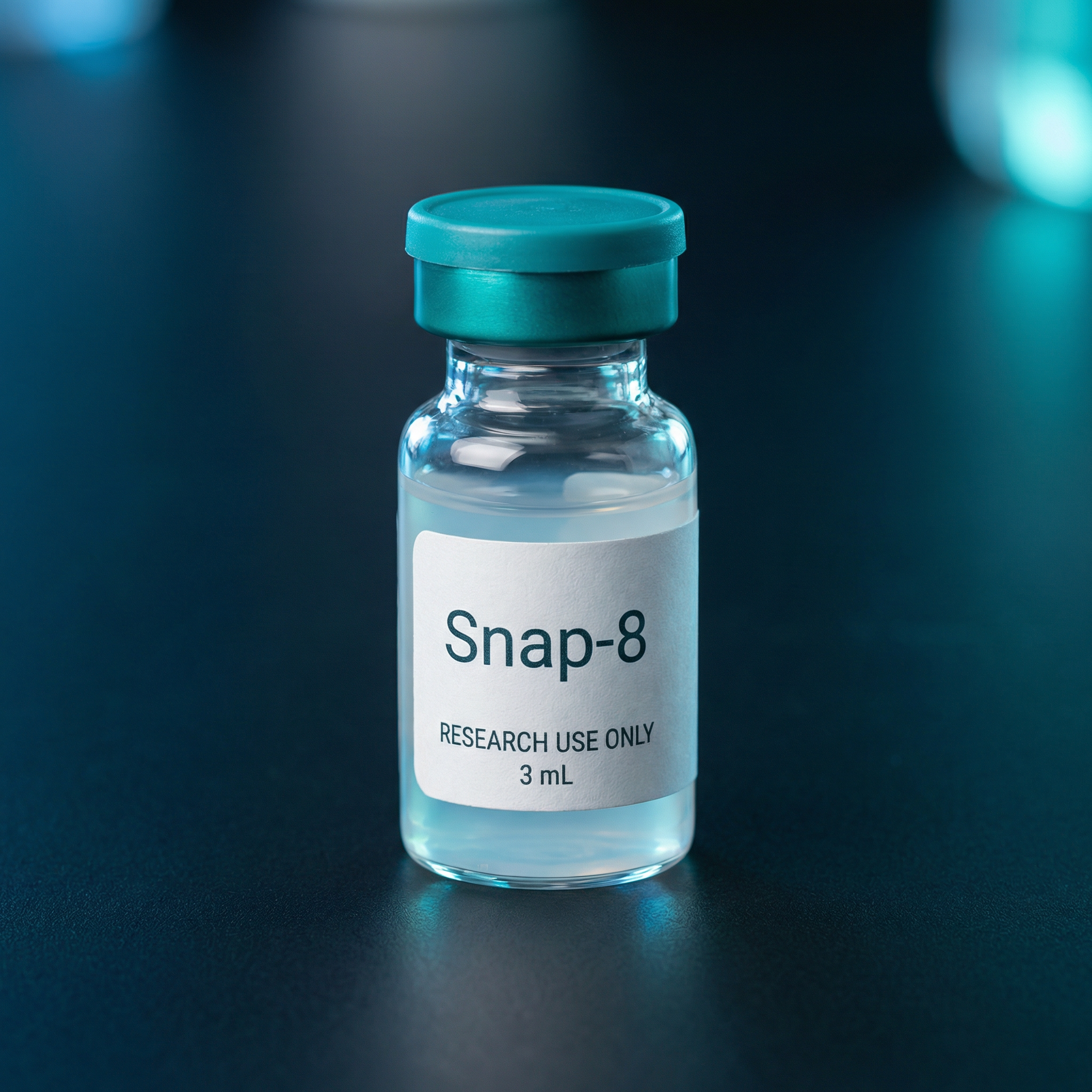
Snap-8 is best understood as a cosmeceutical peptide ingredient, not as a mainstream therapeutic peptide drug. It is marketed for reducing the appearance of expression lines and is often described as an expanded successor to Argireline because it targets the same broad idea of SNARE-complex interference in facial-expression signaling. In a peptide research repository, Snap-8 belongs in the cosmetic-peptide subset: relevant for topical formulation science, modest clinical-cosmetic outcomes, and delivery-mechanism debates, but not for systemic therapeutic medicine.
Important names include Snap-8, SNAP-8, and acetyl octapeptide-3. The INCI-style identity is especially important because cosmetic products often use ingredient nomenclature rather than pharmaceutical naming. Repository users should not confuse Snap-8 with botulinum toxin or with approved neuromuscular therapeutics; it is a topical cosmetic peptide ingredient with a very different evidence and regulatory position.
3. Sequence and structure
Public identity sources describe Snap-8 as Ac-Glu-Glu-Met-Gln-Arg-Arg-Ala-Asp-NH2, an acetylated octapeptide. It is a linear short peptide and can be viewed as an elongated analog of acetyl hexapeptide-8 / Argireline. The molecule is structurally straightforward compared with drug peptides, but formulation context is critical because its practical use depends on stability and topical delivery rather than systemic pharmacokinetics.
Snap-8 is usually classified as a neurotransmitter-inhibitor cosmetic peptide. The intended mechanism is competition with components of the SNARE machinery involved in acetylcholine release, thereby reducing the appearance of expression-line formation. However, the key scientific caveat is delivery: topical peptides do not automatically reach neuromuscular junctions at meaningful concentrations. The repository should therefore describe the mechanism as plausible in vitro and formulation-dependent in vivo, with more modest real-world expectations than injectables such as botulinum toxin.
The relevant use case is cosmetic improvement of fine lines, especially forehead and periocular expression lines. It is not an approved treatment for neuromuscular disease, spasticity, migraine, or severe hyperhidrosis. In a research context, Snap-8 belongs to topical anti-aging formulation work and cosmetic clinical testing rather than systemic therapy development.
Classic systemic ADME framing is of limited value because Snap-8 is primarily a topical cosmetic ingredient. The main practical pharmacology questions involve skin penetration, formulation stability, peptide preservation in emulsions or serums, and whether enough intact peptide reaches relevant superficial targets to influence wrinkle appearance. These issues are heavily formulation-dependent and far less standardized than with approved peptide drugs.
The evidence supports modest cosmetic benefits rather than dramatic drug-like effects. Cosmetic studies and peptide reviews suggest visible improvement in wrinkle appearance may occur in some formulations, but the magnitude of effect is much smaller and more variable than with injected neurotoxins. The repository should present Snap-8 as a plausible supportive cosmeceutical active, not as a noninvasive equivalent of Botox.
Topical tolerability is generally favorable, with irritation or formulation sensitivity being more relevant than systemic toxicity in normal cosmetic use. The main safety issue is overstatement rather than severe intrinsic risk: consumers may assume a pharmacologic depth of action that the topical delivery profile does not reliably support. For repository purposes, safety should be rated as relatively benign in standard cosmetic contexts but with the usual caveat of variable product quality and accompanying ingredients.
Snap-8 is usually incorporated into cosmetic serums, creams, or aqueous concentrates at manufacturer-selected concentrations. Because it is not an approved systemic drug, dosing should be recorded as formulation concentration and application pattern rather than as a conventional medical dose. Product-specific cosmetic instructions vary widely.
UNVERIFIED RESEARCHER-REPORTED DOSING INFORMATION
The following dosing information has been compiled from community forums, researcher discussions, and gray-market sources. This information has NOT been verified through peer-reviewed scientific studies or clinical trials. It does NOT constitute medical advice, a prescription, or a recommendation for human use.
This data is presented solely for informational and educational purposes to document what is commonly discussed in research communities. Dosing protocols may be inaccurate, dangerous, or based on anecdotal reports with no scientific validation. Individual responses vary significantly, and unregulated compounds carry inherent risks including contamination, mislabeling, and unknown side effects.
Always consult qualified medical professionals before making any health-related decisions. The repository maintainers assume no liability for the use or misuse of this information.
Researcher-Reported Dosing Protocols
Common Dose Range: 3-10% concentration in a topical formulation
Administration Route: Topical
Frequency: Once to twice daily
Timing: Morning and/or evening. Evening application is often preferred to coincide with the skin's overnight repair processes. For maximum benefit, twice-daily application is common.
Schedule / Protocol: Continuous daily use, with results typically observed after 4-8 weeks. Some protocols suggest starting with a lower concentration for the first 4 weeks.
Dose Escalation: It is commonly recommended to start with a lower concentration (e.g., 3%) to assess skin tolerance. If well-tolerated after 4+ weeks and results have plateaued, the concentration can be increased to 5% or up to 10% for more intensive treatment. If any irritation, redness, or dryness occurs, the concentration or frequency should be reduced.
Additional Notes: Snap-8 is a cosmetic peptide for topical use and is not intended for injection. It is applied to clean, dry skin, focusing on areas with expression lines such as the forehead, around the eyes (crow's feet), and between the eyebrows. It is often formulated in serums or creams and can be used in combination with other peptides like Matrixyl or GHK-Cu.
This researcher-reported dosing information was compiled from unverified community sources and does not represent validated scientific or medical guidance.
No major therapeutic-drug clinical-trial program is associated with Snap-8. Relevant evidence comes from cosmetic-use testing, small formulation studies, and broader reviews of topical peptide ingredients. That should be reflected in the database taxonomy.
Snap-8 is best categorized as a cosmetic ingredient, not an FDA-approved therapeutic peptide. Its regulatory footprint depends on cosmetic-ingredient and product-category rules rather than formal drug approval for the core peptide itself. Repository status should therefore be cosmetic / non-drug.
13. References and source quality
Highest-value sources include PubChem or other identity databases for structural confirmation, INCI / substance records, and recent peer-reviewed reviews of peptides in cosmetics. Source quality is decent for identity and mechanism framing, but clinical-outcome evidence is lighter and often product-linked. Marketing claims should be treated cautiously unless backed by peer-reviewed formulation studies.
Snap-8 is typically supplied as a raw cosmetic peptide ingredient or pre-dissolved cosmetic active for incorporation into serums and creams. Manufacturing should focus on peptide purity, solvent system, preservative compatibility, pH range, and stability within the final formula. Since performance is heavily formulation-dependent, the formulation layer matters more here than for many injectable peptide entries.
Version 0.1 starter entry created March 14, 2026. Evidence basis for this draft: public structural records for acetyl octapeptide-3 and recent peer-reviewed reviews of peptides in cosmetics. Recommended future upgrade: add formulation-specific comparative data versus Argireline if a preferred evidence standard is chosen.