SS-31
Mitochondria-targeted tetrapeptide, also known as elamipretide, now carrying U.S. accelerated approval in Barth syndrome while still under broader investigation in mitochondrial disease.
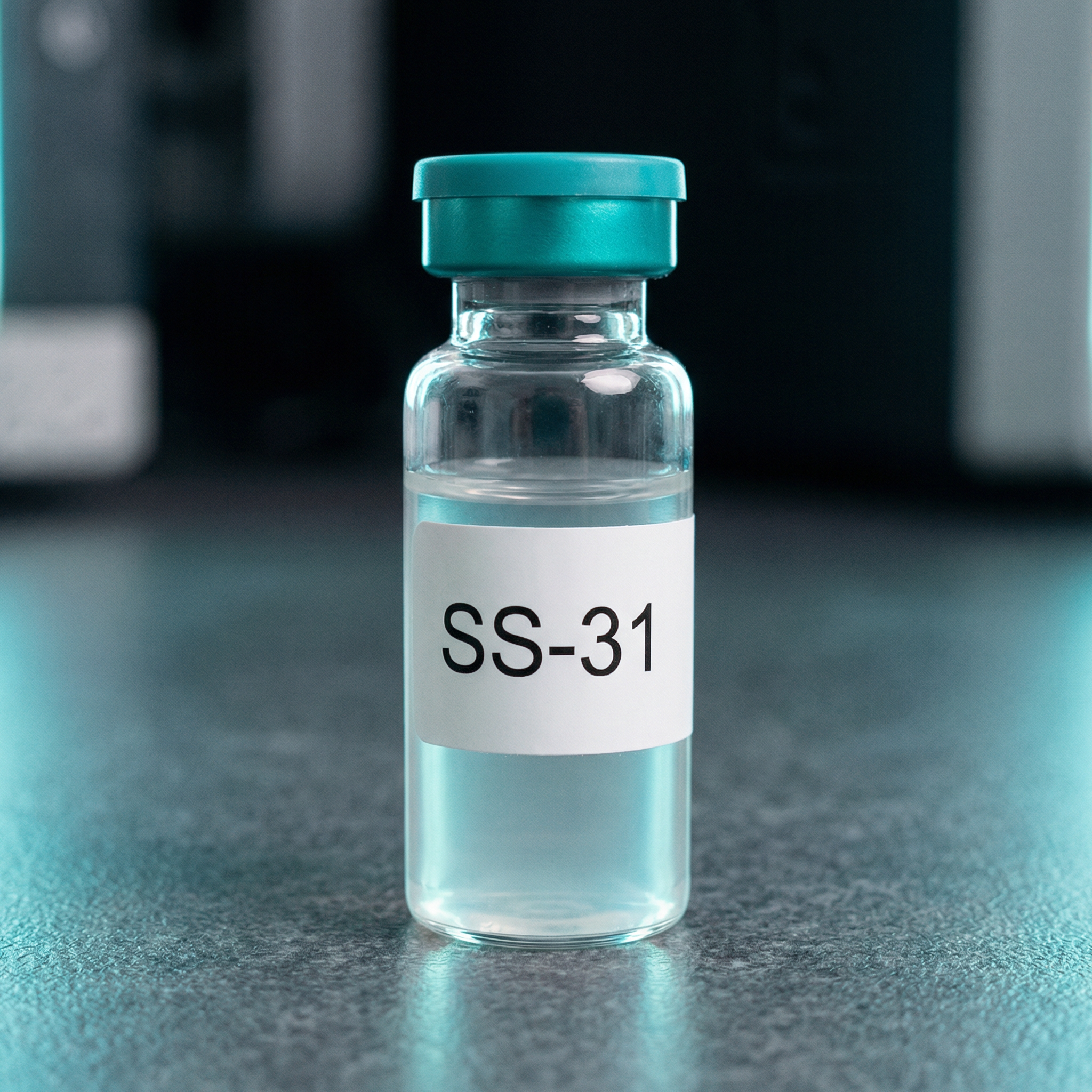
SS-31, now widely recognized under the generic name elamipretide, has moved from niche mitochondrial peptide research into approved-drug territory. As of the current evidence set used for this update, elamipretide has U.S. accelerated approval for Barth syndrome under the brand Forzinity, making it one of the more consequential entries in the repository. This substantially changes how it should be framed: not merely as a speculative longevity or mitochondrial peptide, but as an approved, clinically developed peptide with ongoing investigation in additional mitochondrial-dysfunction settings.
Important names include SS-31, elamipretide, MTP-131, Bendavia, and Forzinity. Identity management matters because older literature often uses one of the legacy development names rather than the now-approval-relevant generic or brand name. This entry should therefore cross-index all major aliases so users can connect early mitochondrial papers to the current regulatory identity.
3. Sequence and structure
SS-31 / elamipretide is a synthetic tetrapeptide with the sequence D-Arg-2,6-dimethyl-Tyr-Lys-Phe-NH2. It is an aromatic-cationic mitochondria-targeting peptide rather than a classic hormone analog. The structural design is central to function: it accumulates at the inner mitochondrial membrane and interacts with cardiolipin, giving it a distinctive position in peptide chemistry and mitochondrial pharmacology.
The core mechanism is cardiolipin binding and stabilization of inner-mitochondrial-membrane architecture, with downstream effects on electron-transport efficiency, supercomplex organization, reactive-oxygen-species stress, and cellular bioenergetics. This is a mechanistically coherent peptide story and one of the better-resolved entries in the database. Unlike many marketed peptides, SS-31 is not about stimulating a classic endocrine receptor; it is about organelle-level membrane biophysics and mitochondrial function.
The most important current indication is Barth syndrome, where elamipretide now holds U.S. approval to improve muscle strength in defined patients. Additional investigational settings include primary mitochondrial disease and dry age-related macular degeneration, among others. In longevity and biohacking circles SS-31 is often discussed much more broadly, but the repository should keep approved and investigational uses clearly separated from speculative anti-aging narratives.
Current labeling supports a much stronger PK summary than most research peptides allow. Following subcutaneous administration, exposure is high, Tmax occurs within about an hour, bioavailability is approximately 92%, and accumulation is limited across the labeled dose range. These are unusually concrete ADME details for a peptide entry and should be preserved because they distinguish SS-31 from loosely characterized mitochondrial products.
Efficacy evidence is strongest in Barth syndrome, where the package of open-label and supportive clinical data was sufficient for accelerated approval. Evidence outside Barth syndrome is more mixed and indication-dependent. That should be reflected directly in the database: strong relevance for Barth syndrome, meaningful investigational potential elsewhere, but not universal proof across all mitochondrial-dysfunction claims found online.
The approved-drug setting provides a far better safety foundation than most peptides in this repository. Injection-site reactions and routine product-label safety considerations are relevant, but the larger message is that SS-31 is no longer operating only in the gray zone of preclinical mitochondrial enthusiasm. That said, broader off-label or non-approved use cases still outrun the evidence, and formulation/source quality remains important outside the labeled product channel.
This entry should prioritize approved-product dosing architecture over gray-market conventions. Forzinity is a ready-to-use subcutaneous product with product-specific daily administration instructions and labeled handling requirements. Any alternative use pattern should be clearly segregated from the approved regimen rather than merged into one field.
UNVERIFIED RESEARCHER-REPORTED DOSING INFORMATION
The following dosing information has been compiled from community forums, researcher discussions, and gray-market sources. This information has NOT been verified through peer-reviewed scientific studies or clinical trials. It does NOT constitute medical advice, a prescription, or a recommendation for human use.
This data is presented solely for informational and educational purposes to document what is commonly discussed in research communities. Dosing protocols may be inaccurate, dangerous, or based on anecdotal reports with no scientific validation. Individual responses vary significantly, and unregulated compounds carry inherent risks including contamination, mislabeling, and unknown side effects.
Always consult qualified medical professionals before making any health-related decisions. The repository maintainers assume no liability for the use or misuse of this information.
Researcher-Reported Dosing Protocols
Common Dose Range: 5-20 mg per day
Administration Route: Subcutaneous injection
Frequency: Once daily
Timing: Consistent time of day
Schedule / Protocol: 8-12 week cycles
Dose Escalation: Start at 5 mg daily for the first 1-2 weeks to assess tolerance, then increase to a target dose of 10-20 mg daily.
Additional Notes: Doses in the 15-20mg range are considered advanced and based on clinical trial protocols for severe conditions. Use beyond 12 weeks has not been extensively studied.
This researcher-reported dosing information was compiled from unverified community sources and does not represent validated scientific or medical guidance.
Clinical development includes Barth syndrome programs that culminated in U.S. accelerated approval, as well as ongoing ophthalmic and mitochondrial-disease work. Stealth BioTherapeutics continues to maintain additional development and lifecycle-expansion activity. Compared with most peptides in the repository, SS-31 has an unusually modern and documentable trial history.
As of this March 2026 repository update, elamipretide / SS-31 is U.S. FDA accelerated-approved for Barth syndrome under the name Forzinity. That approval followed earlier regulatory setbacks and a resubmission process, so the entry should preserve that history rather than presenting approval as a simple linear story. No equivalent broad global approval footprint was confirmed in the public source set used for this draft.
13. References and source quality
Highest-value sources include the 2025 FDA label and approval documents for Forzinity, Stealth BioTherapeutics pipeline and regulatory updates, and recent peer-reviewed reviews of elamipretide in mitochondrial disease. Source quality for approved-indication identity and PK is high. Broader anti-aging or performance claims remain much lower confidence and should not be allowed to outrank the labeled evidence base.
The approved product is a ready-to-use sterile aqueous formulation rather than a generic lyophilized research vial. Manufacturing and formulation records should capture the hydrochloride form, sterile presentation, storage, single-patient-use configuration, and any product-specific handling requirements from the label. This is a meaningful distinction from the many research-vendor versions of SS-31 historically sold online.
Version 0.1 starter entry created March 14, 2026. Evidence basis for this draft: current FDA approval and labeling documents for Forzinity, Stealth BioTherapeutics 2026 pipeline disclosures, and recent peer-reviewed elamipretide reviews. Recommended future upgrade: add specific trial identifiers and any confirmatory post-marketing study milestones.