TB-500 (Thymosin Beta-4 Acetate)
Market shorthand for thymosin-beta-4-related repair peptides, with strong preclinical regeneration biology but unsettled product identity and weak standardized human evidence under the TB-500 label.
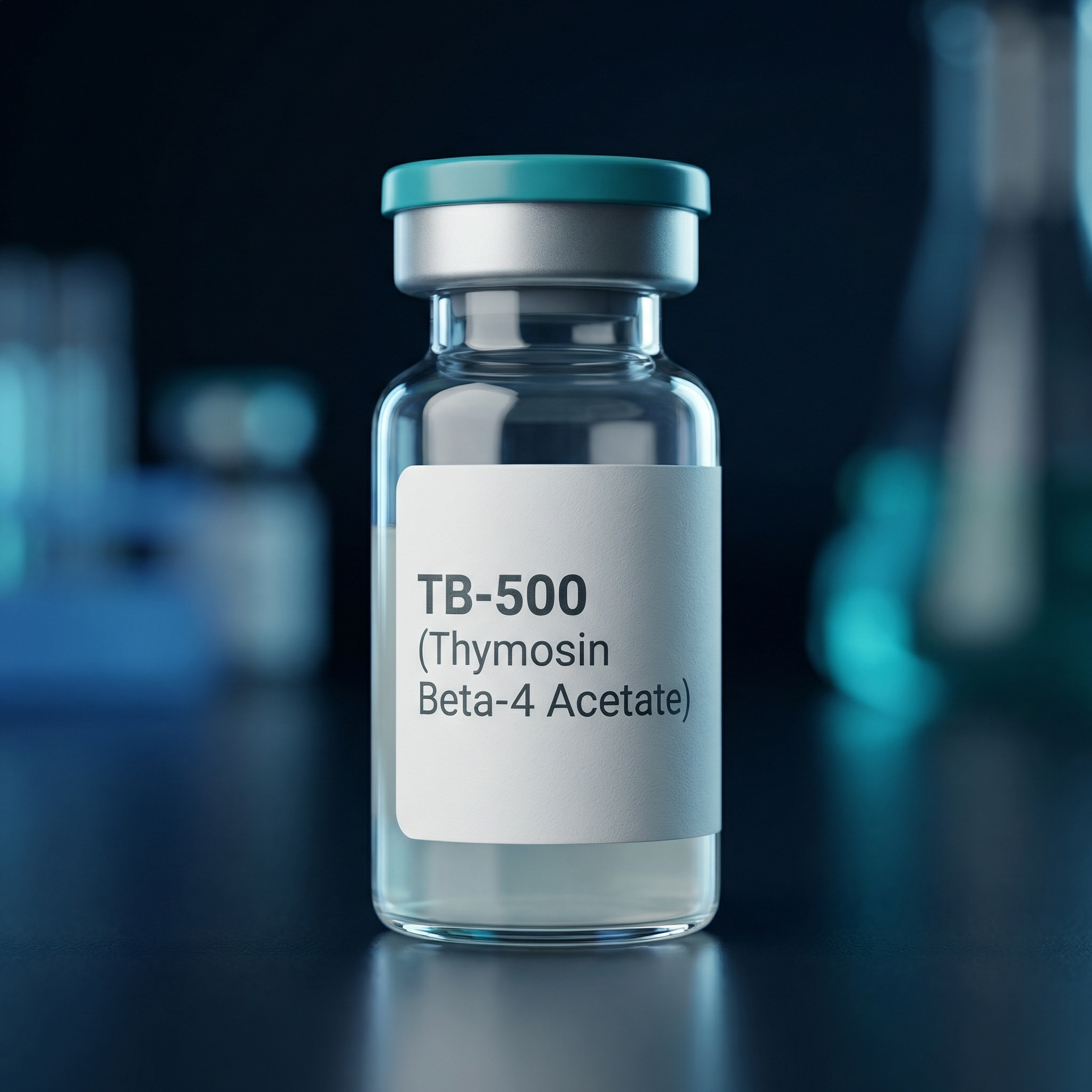
TB-500 is one of the most commercially discussed repair-oriented peptides, but it is also one of the messiest from an identity and evidence perspective. The name is commonly used as shorthand for a synthetic thymosin-beta-4-related product, yet what vendors sell under TB-500 is not always identical to full thymosin beta-4. The repository should treat TB-500 as a market-facing identity anchored to thymosin-beta-4 biology, not as a single perfectly standardized pharmaceutical entity. This distinction is essential if the database is meant to be credible.
Important names include TB-500, thymosin beta-4 acetate, Tbeta4, and thymosin beta-4-related repair peptide. However, these terms are not interchangeable in a strict pharmaceutical sense. Full endogenous thymosin beta-4 is a 43-amino-acid peptide with a substantial wound-healing literature, while TB-500 in commercial peptide markets may refer to full-length material or to a loosely standardized synthetic analog identity. The naming section should preserve that ambiguity rather than conceal it.
3. Sequence and structure
Section 3 should explicitly state that product identity under the TB-500 label is inconsistent. Full thymosin beta-4 is a 43-amino-acid peptide, but many TB-500 vendors do not provide the same level of structural rigor expected of approved peptide drugs. If a repository user needs exact sequence-level certainty, the recommended approach is to verify whether the source is full-length thymosin beta-4 acetate or another defined construct rather than assuming that every TB-500 vial means the same thing.
The mechanistic story derives largely from thymosin beta-4 biology: actin binding, cell migration support, angiogenesis-related signaling, tissue remodeling, cytoprotection, and wound-repair processes. This is why TB-500 is so often discussed in injury and regeneration settings. The mechanism is biologically plausible and strongly supported at the thymosin-beta-4 level, but the repository should still distinguish between full-molecule biology and claims made for inconsistent TB-500-branded products.
Typical claimed use cases include tendon and ligament injury, muscle recovery, wound healing, cardiac repair, and general tissue regeneration. These should all be labeled as investigational or community-driven unless tied to specific clinical research on thymosin beta-4. There is no broad approved mainstream indication for TB-500 itself. The repository should therefore emphasize preclinical rationale over established human therapeutic status.
Public human PK data specific to TB-500 as sold in peptide markets are sparse and not robust enough to justify precise claims. Any pharmacology summary should instead note that thymosin-beta-4-related peptides are generally handled as injectable biologics with uncertain real-world exposure characteristics when sold outside controlled clinical manufacturing. Product identity uncertainty again limits how confidently ADME can be summarized.
Preclinical efficacy signals for thymosin beta-4 biology are real and substantial, especially in wound repair, cardiac injury, and tissue-restoration models. Human evidence under the exact TB-500 branding, however, is far weaker and much less standardized. The repository should therefore score this as strong preclinical biology with limited standardized human clinical validation for the commercial TB-500 identity.
Formal large-scale human safety data are lacking for TB-500 as a branded market peptide. The most important risks are product variability, contamination, incorrect identity, and overextension of promising animal data into unsupervised human use. These risks are amplified by the peptide's popularity in gray-market and performance-oriented communities. Safety should be labeled as incompletely characterized rather than assumed favorable.
Because there is no approved standardized TB-500 medical product, dosing information should be handled cautiously and ideally source-linked rather than generalized. In practical markets, the compound is usually sold as an injectable lyophilized product, but that does not create a validated therapeutic regimen. The repository should record route conventions without normalizing them as established medicine.
UNVERIFIED RESEARCHER-REPORTED DOSING INFORMATION
The following dosing information has been compiled from community forums, researcher discussions, and gray-market sources. This information has NOT been verified through peer-reviewed scientific studies or clinical trials. It does NOT constitute medical advice, a prescription, or a recommendation for human use.
This data is presented solely for informational and educational purposes to document what is commonly discussed in research communities. Dosing protocols may be inaccurate, dangerous, or based on anecdotal reports with no scientific validation. Individual responses vary significantly, and unregulated compounds carry inherent risks including contamination, mislabeling, and unknown side effects.
Always consult qualified medical professionals before making any health-related decisions. The repository maintainers assume no liability for the use or misuse of this information.
Researcher-Reported Dosing Protocols
Common Dose Range: 1-2.5 mg per injection, or 4-8 mg per week
Administration Route: Subcutaneous or Intramuscular injection
Frequency: Daily to 3 times per week during the initial phase, reducing to 1-2 times per week for maintenance.
Timing: No specific timing is consistently reported, but morning injections are sometimes mentioned.
Schedule / Protocol: 6-12 week cycles are commonly reported, sometimes followed by a lower-dose maintenance protocol.
Dose Escalation: A common approach involves an initial 'loading' phase with higher frequency and dosage for the first few weeks, followed by a de-escalation to a lower-dose maintenance phase.
Additional Notes: Dosing protocols often differentiate between an initial 'loading' or 'acute phase' and a longer-term 'maintenance phase'. The initial phase uses higher doses to quickly raise levels in the body, while the maintenance phase uses lower doses to sustain the effects.
This researcher-reported dosing information was compiled from unverified community sources and does not represent validated scientific or medical guidance.
Clinical development is easier to document for thymosin beta-4-related biology than for TB-500 as a commercial peptide identity. The repository should note that human translational work exists in the broader thymosin-beta-4 field, but a clean modern registrational program for TB-500-branded human therapy was not identified. This is an area where ontology matters: biology is stronger than the specific market label.
TB-500 is not FDA approved and does not have mainstream regulatory approval as a human therapeutic drug. It should be classified as a non-approved, repair-focused peptide-market identity with strong thymosin-beta-4-related preclinical rationale and weak standardized regulatory grounding.
13. References and source quality
Highest-value sources include foundational thymosin-beta-4 preclinical papers and review literature on regenerative applications, plus reliable discussions of how TB-500 differs from full Tbeta4 where such clarification is available. Source quality is strong for background biology, moderate for translational potential, and poor for many market-specific human claims. This entry especially benefits from source-quality grading.
Commercial TB-500 is usually sold as a lyophilized injectable peptide product, often in acetate form, but manufacturing transparency varies widely. Sequence confirmation, peptide content, purity, and excipient disclosure are all important because brand-level identity is not fully standardized. This makes manufacturing metadata unusually important for this entry.
Version 0.1 starter entry created March 14, 2026. Evidence basis for this draft: thymosin-beta-4 preclinical literature, modern overview sources discussing TB-500, and public reporting on the risks of gray-market peptide products. Recommended future upgrade: split TB-500 and full thymosin beta-4 into linked but distinct records if source documentation becomes cleaner.